
Why your weight trend reads higher than the scale (Hacker's Diet)
A trend line reads high on a falling weight because it is still catching up, and John Walker's 1991 filter catches up slowly by design: it never fills a day you skipped, so it steps once per weigh-in rather than once per calendar day. On one user's log — 84 weigh-ins over 225 days — it ends at 186.0 lb where the last scale reading was 183.0, and the same alpha with gap-filling on ends at 184.5.
Where does the 0.1 smoothing constant come from?
John Walker signed the preface of The Hacker’s Diet in Sausalito in January 1991, thirty-five years ago. He had helped found Autodesk in 1982 and rewritten, with Michael Riddle, the program that became AutoCAD; the book is what happened when he pointed that habit of mind at his own scale. It went up as a free web edition in 1994 and was reissued as a fourth edition in 2005, which is the one still online.
The trend line arrives in the chapter “Signal and Noise”. Walker walks the reader up through a 10-day moving average, then weighted averages, then lands on exponential smoothing — a technique already at work, he notes, in air-defence radar and commodity trading.
His phrasing trips people up. Walker’s smoothing constant is 0.9, and that is not the weight given to today’s reading. The weight factors in his scheme are successive powers of the constant: 1, 0.9, 0.81, 0.729, and so on backwards through your log. Normalise that infinite series and it sums to 10, so the newest reading ends up carrying 1 − 0.9 = 10% of the answer. Walker checks his own arithmetic in the text: against a 20-day simple average, where every day gets 1/20 = 5%, exponential smoothing at 0.9 gives today twice that.
He describes the result as “roughly equivalent to a 20 day simple moving average” in lag. The exact figure is 19. Mean age of the data in an EWMA is (1 − α)/α = 9 days; in an N-day simple average it is (N − 1)/2. Set those equal and N comes out at 19.
What is the Hacker’s Diet weight trend formula?
Much later in the book, in the reference chapter “Pencil and Paper”, he writes the recurrence out:
T_n = T_(n−1) + 0.1 × (W_n − T_(n−1))The surrounding instructions are the recurrence in words. Subtract yesterday’s trend number from today’s weight. Shift the decimal point one place to the left. Round to one decimal. Add it to yesterday’s trend. Walker says outright why the constant is a tenth: shifting the decimal avoids a division, a dodge financial analysts had been using for decades on hand-drawn stock and commodity charts.
Peptrend prints the algebraically identical rearrangement in the method explainer: T_t = 0.1 × W_t + 0.9 × T_t-1. Multiply out Walker’s version and you get the same line, point for point. Only the bookkeeping differs.
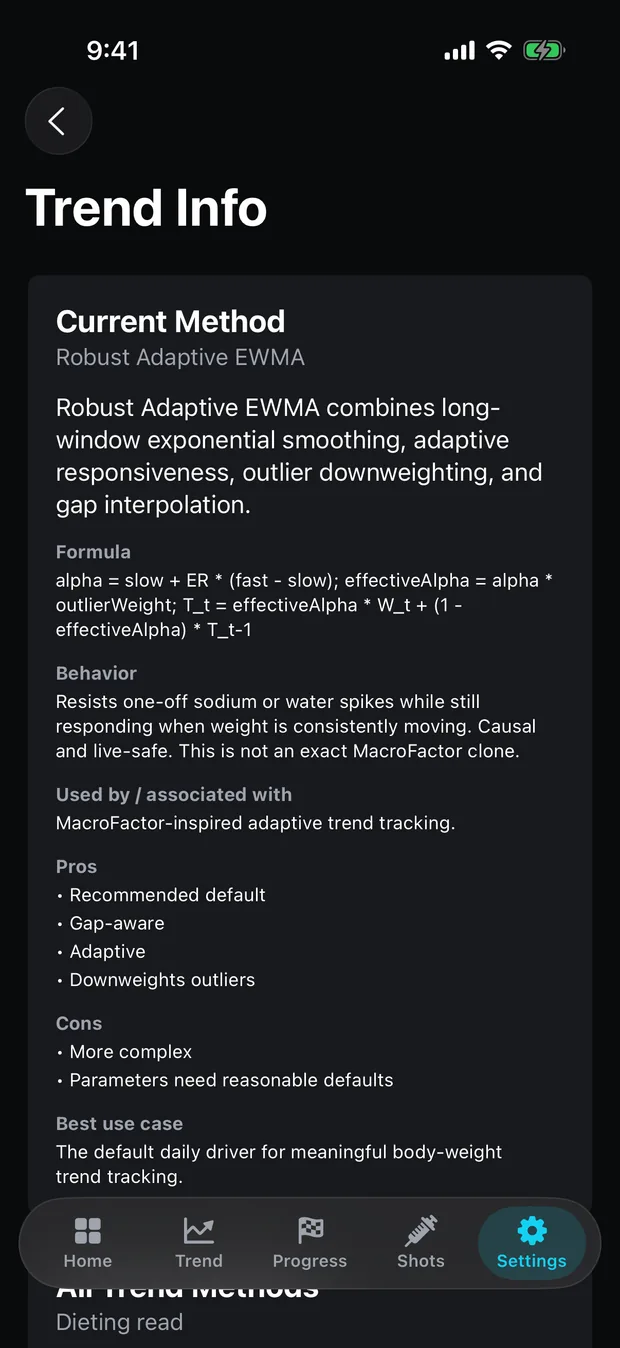
A formula that survives being done by hand for thirty-five years has earned a short-list place, which is why the method sits in Peptrend’s Simple Mode list alongside Robust Adaptive EWMA, Weekly Average and Rolling Median, rather than behind Advanced Mode with the other eleven. One footnote for 1.4.0, coming soon: a fresh install starts it hidden from the method strip, and the eye toggle in Settings shows it.
Why can’t you change the alpha?
Because the constant is the method. Peptrend already ships a plain EWMA with a user-editable alpha that starts at 0.1, so a Hacker’s Diet method with a movable alpha would be the same calculator wearing a second name. The Hacker’s Diet calculator therefore takes a hard-coded 0.1 and ignores the alpha setting entirely — move the slider in the parameter editor and you move EWMA, DEMA and TEMA, while this line stays exactly where Walker left it.
The trade is honest. You give up tuning and you get a number you can reproduce on paper, with the same constant every reader of the book has used since 1991. If nine days of mean data age feels too slow for you, switch methods rather than bend this one. Lag is the whole SMA-versus-EWMA argument, and Peptrend would rather you make that choice explicitly than smuggle it in under a historical label. The full method list shows what each one costs you.
Does the line fill in the days you skipped?
No, never. Same recurrence, same alpha — the only thing separating Peptrend’s Hacker’s Diet from its plain EWMA at default settings is what happens on days you did not step on the scale. Hacker’s Diet hard-overrides the global interpolation setting to off. EWMA follows that setting, which ships on.
Walker’s log had a line for every day of the month and one arithmetic step for every weight you wrote down. Nothing in his recurrence mentions elapsed time. Skip Tuesday and Wednesday, and Thursday’s reading is still worth exactly 10%.
The other convention is equally defensible and equally well documented. TrendWeight, the free open-source web tracker, cites the same book, publishes the same α = 0.1, and then draws a straight line between your two real weights to manufacture the missing days. One lineage, two lines that never quite meet. What interpolation does to a trend line is a bigger effect than most people expect, and it is most of what separates Peptrend from TrendWeight mathematically.
On one user’s log — 84 weigh-ins over 225 days — the two finish 1.5 lb apart: Hacker’s Diet at 186.0 lb, EWMA at 184.5 lb. Identical formula, identical constant, different answer.
Why does it finish 3.0 lb above the last weigh-in?
Because 84 weigh-ins across 225 days means the log covers 37% of the days, and with gap-filling off the filter takes 84 steps where the interpolated methods take 226. Each step closes a tenth of the distance. Take a third as many steps down a falling series and the line simply has not arrived yet.
Here is how it sits against the rest, all computed on that same file at the app’s default parameters:
| Method | Line moves/day | Scale movement ignored | Final reading |
|---|---|---|---|
| KAMA | 0.080 lb | 81.3% | 187.0 lb |
| Hacker’s Diet | 0.229 lb | 80.3% | 186.0 lb |
| Robust Adaptive EWMA | 0.094 lb | 78.1% | 185.0 lb |
| EWMA | 0.103 lb | 75.9% | 184.5 lb |
| HMA | 0.368 lb | 14.3% | 182.9 lb |
The last raw scale reading in that log is 183.0 lb. Hacker’s Diet puts the trend 3.0 lb above it; HMA lands on it. Across the fifteen methods measured on this one identical dataset the spread is 4.0 lb.
The second column carries as much as the third. The line ignores 80.3% of the scale’s own daily movement, fourth of the fifteen, behind Weekly Average, LOESS and KAMA. It still moves more than EWMA’s does day to day — 0.229 lb against 0.103 lb — because it does its moving in fewer, larger steps.
Does a 1991 constant still fit a 2026 scale?
For someone weighing most days, yes, and this user’s log shows why. Mean day-over-day change is 1.16 lb with a standard deviation of 1.45 lb, and the largest single-day swing in the log is 5.4 lb. Underlying drift is 0.098 lb/day. Daily noise runs about 12 times the daily signal. A filter built to discard roughly 80% of what the scale says each morning is proportionate to that, and the physiology behind the noise has not changed since Walker was doing this by hand.
Where the method shows its age is everything it does not do. It has no outlier handling: a reading 5 lb off the line drags the trend half a pound in one step, because 10% of a large residual is a large number, and nothing in the recurrence notices that the reading was strange. It does not adapt either — a plateau and a fast cut get the same constant. Peptrend’s default is Robust Adaptive EWMA for exactly those two reasons.
Pick Hacker’s Diet when you want a line whose every point you could check with a pencil, when you weigh most days, and when you would rather the trend lag a falling weight than sprint ahead of it. If you are still deciding, comparing the methods on your own data beats taking anyone’s word for it, including a book from 1991.
Common questions
What is the Hacker's Diet weight trend formula?
T_n = T_(n−1) + 0.1 × (W_n − T_(n−1)). Take today's weight, subtract yesterday's trend number, keep a tenth of the difference, add it back. John Walker printed it in the Pencil and Paper chapter of The Hacker's Diet.
Why can't I change the alpha on Peptrend's Hacker's Diet method?
Because 0.10 is what defines the method. Peptrend also ships plain EWMA with a user-editable alpha that starts at 0.1, so if you want a faster or slower line, move that one instead.
Does the Hacker's Diet line fill in days I didn't weigh?
No. Hacker's Diet ignores the global interpolation setting and never fills a missing day, so it only takes a step on days you actually stepped on the scale.
Why is my trend line higher than my weight?
On a falling weight every smoothed line sits above the scale, because it still holds readings from mornings when you weighed more. Hacker's Diet sits furthest above on one user's log — 186.0 lb against a last reading of 183.0 — because it takes a step only on the days you weighed.