How many units is 1 mg? Why a calculator should stop at mg/mL
A milligram has no unit count until you name the syringe: one unit on a U-100 barrel is 0.01 mL, and what it holds depends on the water in your vial. Peptrend prints mg/mL and stops. A draw volume would be a drug dosage calculator, which Apple's guideline 1.4.2 restricts to manufacturers, hospitals, universities, insurers, pharmacies and FDA-cleared apps. When this sum breaks, it breaks tenfold.
Does the calculator give you a draw volume?
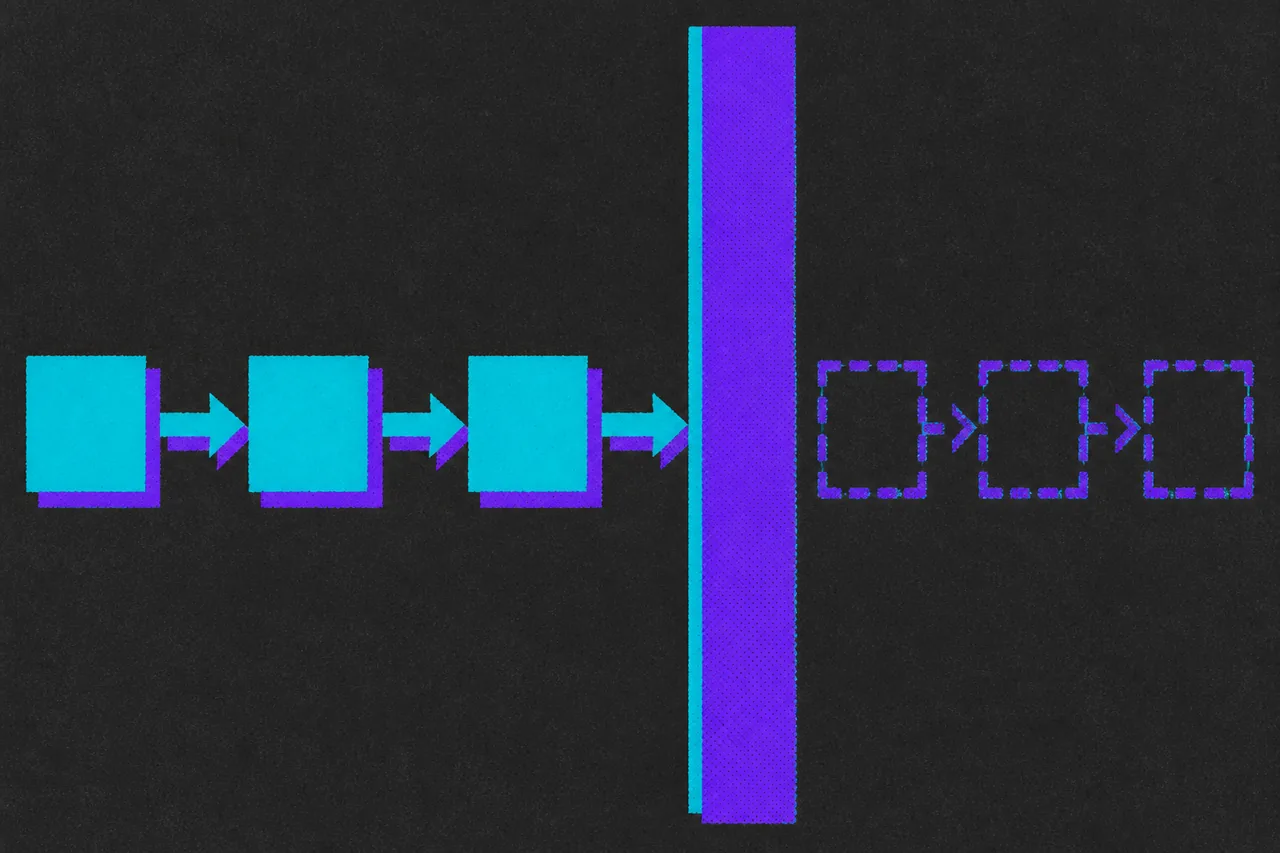
No. Peptrend’s reconstitution sheet takes two numbers and returns one. Vial strength in milligrams goes in, bacteriostatic water in millilitres goes in, and the quotient comes out, printed to two decimal places as mg/mL. There is no third field for a target dose, and no line anywhere on the screen reporting a volume to draw or a count of syringe units.
Two functions used to do that work. volumeML(forDoseMg:) and insulinUnits(forDoseMg:) sat on the vial model and did exactly what their names say. Both were deleted, and a comment holds the space where they were:
There used to be
volumeML(forDoseMg:)andinsulinUnits(forDoseMg:)here: give them a target dose and they returned the volume to draw. That is a drug dosage calculator, which App Review guideline 1.4.2 restricts to manufacturers, hospitals, universities, insurers, pharmacies and FDA-cleared apps. Peptrend is none of those.
concentrationMgPerMLstays. It is a fact about the liquid now in the vial — what you would write on the label — not a recommendation about what to put in a syringe.
Under the result, in the warning colour, the sheet prints the same boundary: “A record of what you mixed, nothing more. Peptrend does not work out what to draw, what to take, or whether to.”
Why won’t an app calculate a drug dose?
Apple’s rule is two sentences long and lives under a heading called Physical Harm, which opens “If your app behaves in a way that risks physical harm, we may reject it.” Guideline 1.4.2 reads:
Drug dosage calculators must come from the drug manufacturer, a hospital, university, health insurance company, pharmacy or other approved entity, or receive approval by the FDA or one of its international counterparts. Given the potential harm to patients, we need to be sure that the app will be supported and updated over the long term.
The second sentence carries the reasoning, and it is about maintenance. Apple wants to know who will still be answering for the arithmetic in five years — who takes the call when a formula turns out to be wrong, or when a syringe standard shifts. Naming a manufacturer, a hospital, a pharmacy or a regulator is a way of demanding that somebody be on the hook.
A personal tracking app puts nobody on the hook. That leaves the choice of pursuing clearance, shipping the feature and hoping review looks the other way, or drawing the line above it and publishing where the line is. How much bacteriostatic water to add works through the division that survives the cut.
How many units is 1 mg of a peptide?
Ask how many units 1 mg of a peptide comes to and the question has no answer until you name a syringe. The word is borrowed from insulin: U-100 insulin is 100 units per millilitre — the Humulin R label gives the strength as 100 units per mL (U-100) — so one unit on a U-100 barrel is 0.01 mL of whatever the barrel happens to contain. Nothing about the powder in your vial gives the word a meaning.
Barrels also disagree about how finely they are marked. A BD Ultra Fine 1 mL insulin syringe is graduated in 0.02 mL steps; the 0.3 mL model from the same product line is graduated in 0.01 mL. One printed line means two units on the first barrel and one unit on the second.
U-500 insulin presses the point harder, because a unit is a scale and scales get redefined. BD launched the first dedicated U-500 syringe in November 2016, marked in 5-unit increments and dosing up to 250 units. Before it existed, people converted doses by hand onto “a traditional U-100 insulin syringe or tuberculin (volumetric) syringe” — a step BD described as one that “could result in dosing errors, which have resulted in patients experiencing hyperglycemia, hypoglycemia or death.”
Peptrend knows one thing about your mix: the concentration it worked out from the two numbers you typed. It cannot see the syringe on the table, and it has no way to test the assumption a unit count would have to make. Such a number would carry something unstated buried inside it.
What goes wrong when milligrams get converted to units?
Dose arithmetic does not degrade gently. When it breaks it tends to break by a power of ten, and three published records show the pattern.
The FDA issued an alert on 29 July 2024 about compounded injectable semaglutide, naming “confusion between different units of measurement (e.g., milliliters, milligrams and ‘units’)” among the causes and reporting that patients had administered “five to 20 times more than the intended dose”. A 2023 case series in the Journal of the American Pharmacists Association followed three such reports to a regional poison control centre. Two of the three “self-administered 10-fold dosing errors”; one “reported dosing in milliliters and units rather than in milligrams”. All three had nausea, vomiting and abdominal pain, most of it lasting for days.
Trained staff make the same error inside hospitals. A January 2026 analysis in Patient Safety went through 74 insulin syringe reports filed by 47 Pennsylvania acute care facilities between 2015 and 2024, drawn from the state’s mandatory reporting system, and found that more than 97% of the wrong-dose errors reaching a patient — 43 of 44 — were overdoses of tenfold or greater. Narrow it to overdoses involving a 1 mL syringe and 20 of 21, 95.2%, were tenfold exactly. Those were staffed hospitals. A kitchen table has less standing between the arithmetic and the needle.
| Source | Setting | Finding |
|---|---|---|
| FDA alert, 29 July 2024 | Patients self-injecting compounded semaglutide | Doses of 5× to 20× the intended amount; mL / mg / “units” confusion named among the causes |
| J Am Pharm Assoc, 2023 | 3 poison-centre reports | 2 of 3 were tenfold errors; one patient dosed in mL and units rather than mg |
| Patient Safety, 30 Jan 2026 | 74 reports, 47 hospitals, 2015–2024 | 43 of 44 wrong doses reaching a patient were tenfold-or-greater overdoses |
Why a wrong trend line is survivable and a wrong dose is not
The rest of Peptrend’s arithmetic describes what has already happened to you, and the worst any of it can do is make you gloomy about a Tuesday. The trend line makes the case against itself: run all fifteen methods over one user’s log — 84 weigh-ins over 225 days — at default settings and the final readings span 4.0 lb, from 182.9 lb on the Hull Moving Average to 187.0 lb on Kaufman’s Adaptive Moving Average. One file, one day, fifteen answers.
That disagreement is real and it is survivable. Nobody is injured by a smoothing constant. Choosing a trend method treats the spread as information, and the fifteen methods sets out what each one is doing to get there.
The other estimates are as approximate and as open about it. The energy deficit card turns weekly pounds into a daily calorie gap with a single constant, and its explainer prints the working — kcal/day = lb per week × 3500 ÷ 7 — under the sentence “peptrend never sees what you ate”. The 30-day projection is the last trend point plus thirty days of the last weekly rate, drawn straight and labelled as such.
A volume to draw is a different kind of object. It is an instruction about the next needle, handed to someone with no second opinion in the room and no way to audit the working. The boundary sits exactly where a number stops describing what happened and starts saying what to do next.
What does the app compute instead?
The app is not squeamish about arithmetic elsewhere. The numbers it does produce come with their own rails and their own hedges.
Goal planning carries a hard cap. GoalPlanValidation refuses any plan above 1.5 lb per week, in both directions and in both schedule modes, and says so in words rather than quietly clamping the figure: “Goal rate cannot exceed 1.5 lb/week”, and, if you set a date instead of a rate, “That target date requires more than 1.5 lb/week. Choose a later date.”
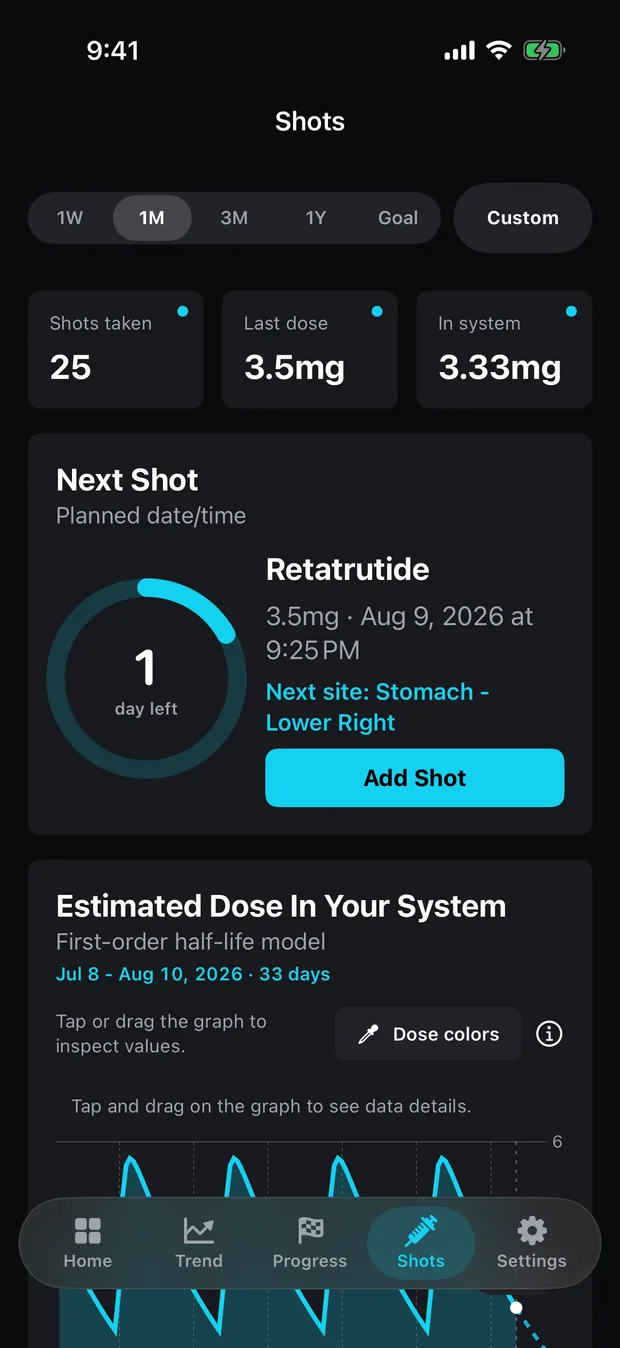
The dose model hedges in its vocabulary. “Estimated Dose In Your System” reports a decayed-and-absorbed milligram amount from a one-compartment model driven by a published half-life and Tmax — no volume of distribution, no clearance, no ng/mL anywhere in it. The word “Circulating” was pulled from that card’s title because it implied a plasma concentration the model never computes, and the panel’s instruction to the reader is “Read the curve as a shape, not a measurement.” Reading the absorption curve goes through what that shape does and does not carry.
So the refusal is narrow and specific. Estimates about your own body get computed and labelled. A number that would stand between you and a syringe never gets computed at all.
What the calculator leaves you with
What survives the boundary is a label. A saved vial holds the medication name, the strength in mg, the diluent in mL, the date and time you mixed it, an optional label and an active flag, and it recomputes the concentration from strength and volume every time it needs to show it, so nothing is ever stored at two decimal places. Saving is a toggle, on by default; you can run the division and keep nothing.
The calculator’s closing line asks for handwriting: “That’s what this vial holds once mixed. Write it on the vial so you don’t have to remember.”
Downstream, that record is what the dose log hangs from. Each dose can be tagged with the vial it came from, the vial history card reports how many shots were drawn from each, and deleting a vial untags its doses instead of taking them with it. Tracking a vial end to end follows one from the mix to the last draw, and what to log with every dose covers the fields that make that history worth having.
The calculator and the vial mix chart are Pro. The vial history card is not, and neither is the log itself — what stays free sets out where that line falls. All of it sits in your own private CloudKit database, with no account and no server of the app’s own behind it, which the privacy page explains in full.
Between those two lines, the app’s position is the one it prints on the screen: it records what you mixed, works out its strength, and stops.
Common questions
How many units of a peptide is 1 mg?
There is no general answer, and Peptrend will not compute one. A unit is a mark on a syringe barrel: on a U-100 insulin syringe one unit is one hundredth of a millilitre, because U-100 insulin is 100 units per mL. What that volume contains depends on how much water went into your vial, and how finely you can read it depends on which barrel you are holding.
Why won't Peptrend's reconstitution calculator give a draw volume?
Because an app that converts a target dose into a volume or a number of syringe units is a drug dosage calculator, and Apple's App Review guideline 1.4.2 restricts those to drug manufacturers, hospitals, universities, health insurance companies, pharmacies, other approved entities, and apps cleared by the FDA or one of its international counterparts. Peptrend is none of those. The two functions that did the conversion were deleted from the code rather than hidden behind a disclaimer.
What does Peptrend do with the concentration once it has it?
It shows it to two decimal places, and — if you leave the save toggle on — stores the vial with its strength, its diluent volume, the mix date and time, and an optional label. Doses can then be tagged to the vial they came from, and the vial history card counts how many were drawn from each. The concentration is recomputed from strength and volume every time it displays, so nothing is ever kept rounded.
Is the reconstitution calculator free?
No. The calculator and the vial mix chart are Pro. The vial history card is not: a record you already saved stays visible whatever you are paying, because taking away a record someone already entered is not a paywall.
Sources
- Apple App Store Review Guidelines — 1.4 Physical Harm, 1.4.2 drug dosage calculators
- FDA — Alerts Health Care Providers, Compounders and Patients of Dosing Errors Associated with Compounded Injectable Semaglutide Products (29 July 2024)
- Lambson, Flegal & Johnson — Administration errors of compounded semaglutide reported to a poison control center: case series, J Am Pharm Assoc, 2023
- Ro & Jones — Large-Scale Insulin Overdoses From Syringe-Related Errors: Analysis and Insights Across 47 Hospitals, Patient Safety, 30 January 2026
- DailyMed — Humulin R, regular insulin human injection USP, 100 units per mL (U-100)
- BD Launches First Syringe Designed for Use with Humulin R U-500 Insulin (8 November 2016)
- BD Ultra Fine 1 mL insulin syringe — 0.02 mL graduations
- BD Ultra Fine 0.3 mL insulin syringe — 0.01 mL graduations