Does a GLP-1 change your VO₂ max? What the number measures
VO₂ max is millilitres of oxygen per kilogram of body mass per minute, so body mass sits in the denominator. In one study of significant weight loss the per-kilogram figure rose 17% while the absolute litres-per-minute figure did not move at all. Apple Watch feeds your weight into its estimate as well, so the number can move in either direction on its own.
VO₂ max is not a number about your lungs alone. Its units are millilitres of oxygen per kilogram of body mass per minute, and the kilogram sits in the denominator. Change the denominator and the number changes, whatever your heart and lungs are doing. Anyone losing weight steadily is changing the denominator every week.
What the units actually say
The reading is a ratio, and only the top half describes oxygen. Absolute oxygen uptake is measured in litres per minute: the volume your body can actually take up and use at maximum effort. Dividing that by your body mass gives the familiar ml/kg·min, which exists so that people of different sizes can be compared on a scale that means something for moving your own body around.
That division has a consequence people rarely state out loud. Two readings taken months apart are not measuring the same person against the same yardstick if the person weighs less at the second reading. The yardstick moved.
Apple Watch supports a VO₂ max range of 14 to 65 ml/kg·min, and records an estimate during Outdoor Walk, Outdoor Run and Hiking workouts on Series 3 or later. The units on your wrist are the same units the laboratory uses, with the same denominator.
The measured size of the effect
One study isolated it directly. Sothern and colleagues followed eleven children and adolescents with obesity through ten weeks of a weight management programme and measured VO₂ max by indirect calorimetry at both ends. The results:
| Measure | At entry | At 10 weeks | Change |
|---|---|---|---|
| BMI | 34.1 | 29.4 | fell, p < 0.0001 |
| VO₂ max, ml/kg·min | 19.2 | 22.4 | rose, p < 0.001 |
| VO₂ max, absolute L/min | not reported | not reported | unchanged |
The per-kilogram figure rose by about 17%. The absolute figure, the one measuring how much oxygen the body could actually use, did not move. The authors concluded that the improvement “seems to result from the reduction in total body weight” rather than from the exercise programme that ran alongside it.
That is a small study in a young population on a very low calorie diet, and it is not a study of any medication. It is useful here for one narrow reason: it separated the two halves of the ratio and showed that the visible number moved while the underlying capacity did not.
Your watch feeds weight into the estimate as well
There is a second route from your weight to your VO₂ max reading, and it has nothing to do with physiology. Apple states plainly that to estimate your cardio fitness level, “your Apple Watch also takes into account your age, sex, weight, height, and medications that might affect your heart rate”.
So your weight enters the number twice. Once as the denominator of the units, and once as an input to the model that produces the estimate in the first place. If you have Peptrend writing weigh-ins back to Apple Health, or you update your weight in Health by hand, you have changed an input to a fitness estimate. That is worth knowing before reading a step in the line as a change in condition.
Peptrend writes body mass to Health and nothing else, and only weigh-ins typed into the app. The ten fitness readings on the Athlete tab, VO₂ max among them, are read-only. See what the app reads from and writes to Apple Health for the exact list.
A flat line can mean you stopped walking outdoors
The estimate only refreshes when you give the watch something to work with. Apple records it during Outdoor Walk, Outdoor Run and Hiking workouts, and says an initial estimate can take at least 24 hours of wear followed by several such workouts plus passive measurement.
That produces a failure mode worth recognising. A month of indoor training, bad weather or travel yields few qualifying workouts, so the readings thin out and the line coasts on old values. Read flat as “no new information” until you have checked how many readings actually fall inside the window.
The Athlete tab is explicit about the sparse case. A metric with nothing in range is named in a line underneath rather than drawn as an empty card, and the trend line needs at least six readings in range before it is drawn at all. Below that you see your readings and no smoothed line, which is the honest rendering of too little data.
Which direction does it move on a GLP-1?
Nobody can tell you, and Peptrend takes no position on it. Body mass falling pushes the per-kilogram figure up. Anything reducing the numerator pushes it down. Training volume, illness, and how often you do the outdoor workouts that generate an estimate at all move it too, and they move on their own schedules.
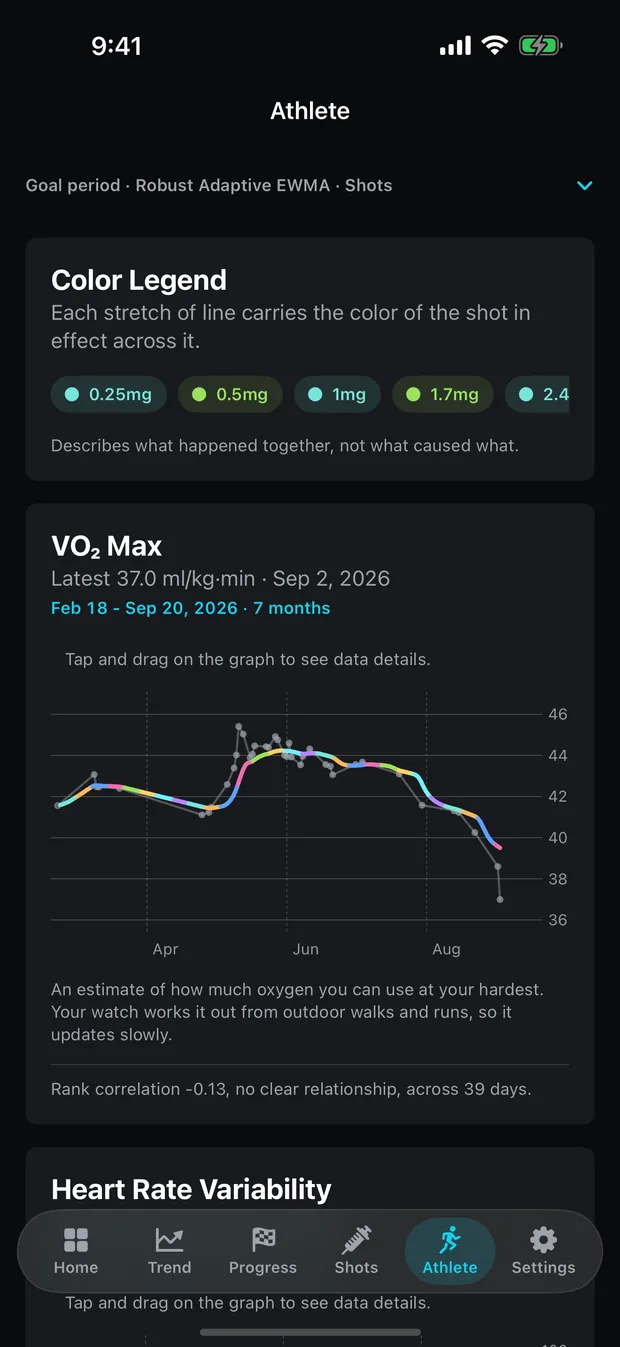
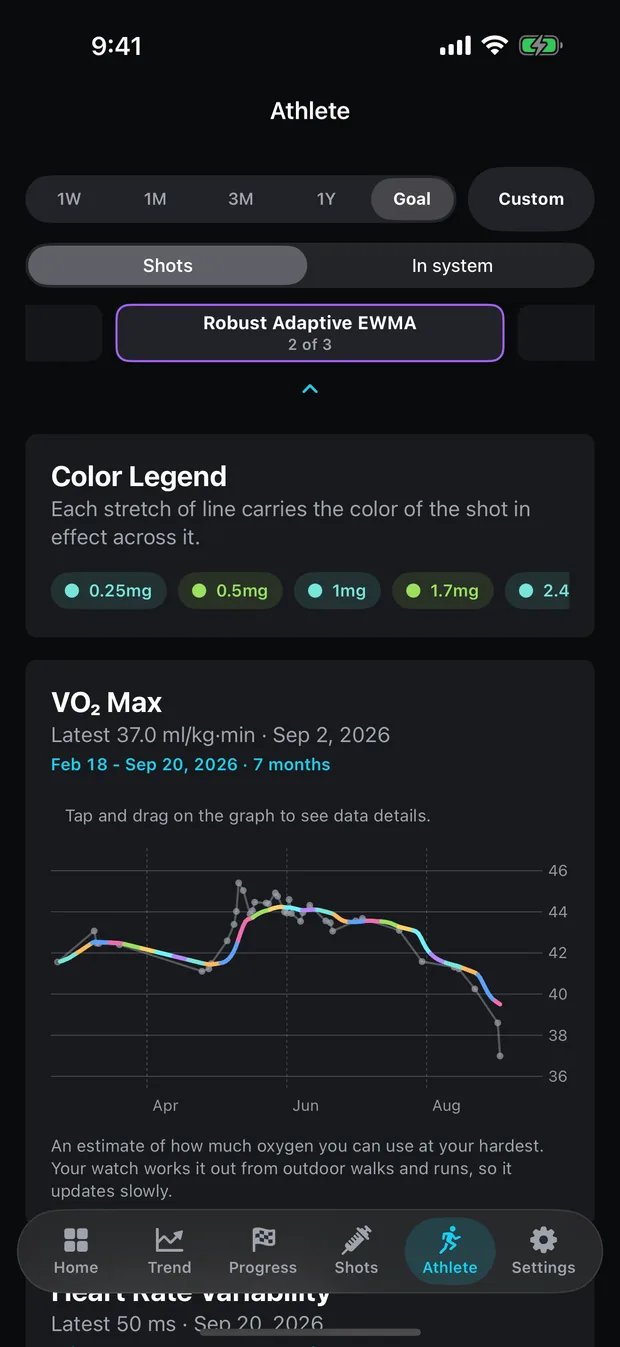
The seven months in the screenshot above show the line falling, from around 42 to around 40 ml/kg·min, across a period with doses logged throughout. A post promising that the number goes up would be contradicted by the app’s own demo data. The honest statement is that the number is a ratio of two things that both move, which is why a single reading tells you less than it appears to.
What the chart reports, and what it refuses to
Athlete Mode draws each metric as your daily readings with a smoothed line over them, coloured by the dose in effect across each stretch. With the correlation setting on, it adds one sentence underneath. In the screenshot it reads “Rank correlation -0.13, no clear relationship, across 39 days”.
Three deliberate choices sit in that sentence. It is Spearman’s rank correlation rather than Pearson, so it only assumes the relationship is monotonic and one freak reading cannot drag it. It needs at least fourteen paired days before reporting anything, because a coefficient over a handful of days is noise with a decimal point. And the strength word is vague on purpose, from “no clear relationship” below 0.2 through to “a strong relationship” above 0.6, because a precise-sounding label would claim more than the data supports.
The app’s own caution sits under the legend: “Describes what happened together, not what caused what.” The sample is one person, over a few months, with no control group and nothing held steady.
Reading your own line without fooling yourself
Three things make the number legible. Note your weight at both ends of any window you are comparing, because the denominator changed between them. Check how many outdoor workouts fall inside the window, since a sparse month produces a stale estimate rather than a real decline. And treat a step that coincides with a weight change as the ratio doing arithmetic until something else says otherwise.
If you want the number that is not scaled by your mass, VO₂ max in ml/kg·min will not give it to you, and neither Apple Health nor Peptrend holds the absolute figure in litres per minute. That measurement comes from a laboratory test.
For how the smoothed line over your readings is computed, the fifteen methods documents each one, and signal and noise on your scale covers the same problem for weigh-ins. Bodyweight is a time series makes the general case for reading a trend rather than a reading.
Common questions
Does losing weight increase your VO₂ max?
The per-kilogram figure usually rises, because body mass is the denominator. Whether your absolute oxygen uptake in litres per minute changes is a separate question, and in one study of significant weight loss it did not change at all.
Does Apple Watch use your weight to estimate VO₂ max?
Yes. Apple states the estimate takes into account your age, sex, weight, height and medications that might affect your heart rate. Changing your weight in Health therefore changes an input to the estimate.
Can Peptrend tell me whether a medication changed my VO₂ max?
No. Athlete Mode draws your readings beside your logged doses and, once fourteen or more days carry both, reports a rank correlation. That describes what happened together over the same days. It does not establish that anything caused anything.
Why does my VO₂ max update so rarely?
Apple Watch records the estimate during Outdoor Walk, Outdoor Run and Hiking workouts, so it only refreshes when you do one of those. Apple says an initial estimate can take at least 24 hours of wear plus several such workouts.
Sources
- Sothern MS, Loftin M, Blecker U, Udall JN Jr. Impact of significant weight loss on maximal oxygen uptake in obese children and adolescents. J Investig Med. 2000;48(6):411-6
- Apple Support: Track your cardio fitness levels
- Apple Developer Documentation: HKQuantityTypeIdentifier.vo2Max
- Wikipedia: Spearman's rank correlation coefficient