
How long until your weight trend catches up? 28 days, or 5
Because smoothing buys steadiness with time: an EWMA at α = 0.1 takes 28 days to absorb 95% of a step. DEMA and TEMA cut that to 8 days and 5, by treating the gap between two smoothing passes as the lag and adding it back. The bill is overshoot — DEMA runs 12% past a step, TEMA 18% — and on one user's log DEMA ignores 64.7% of the scale's daily movement and TEMA 54.4%, against EWMA's 75.9%.
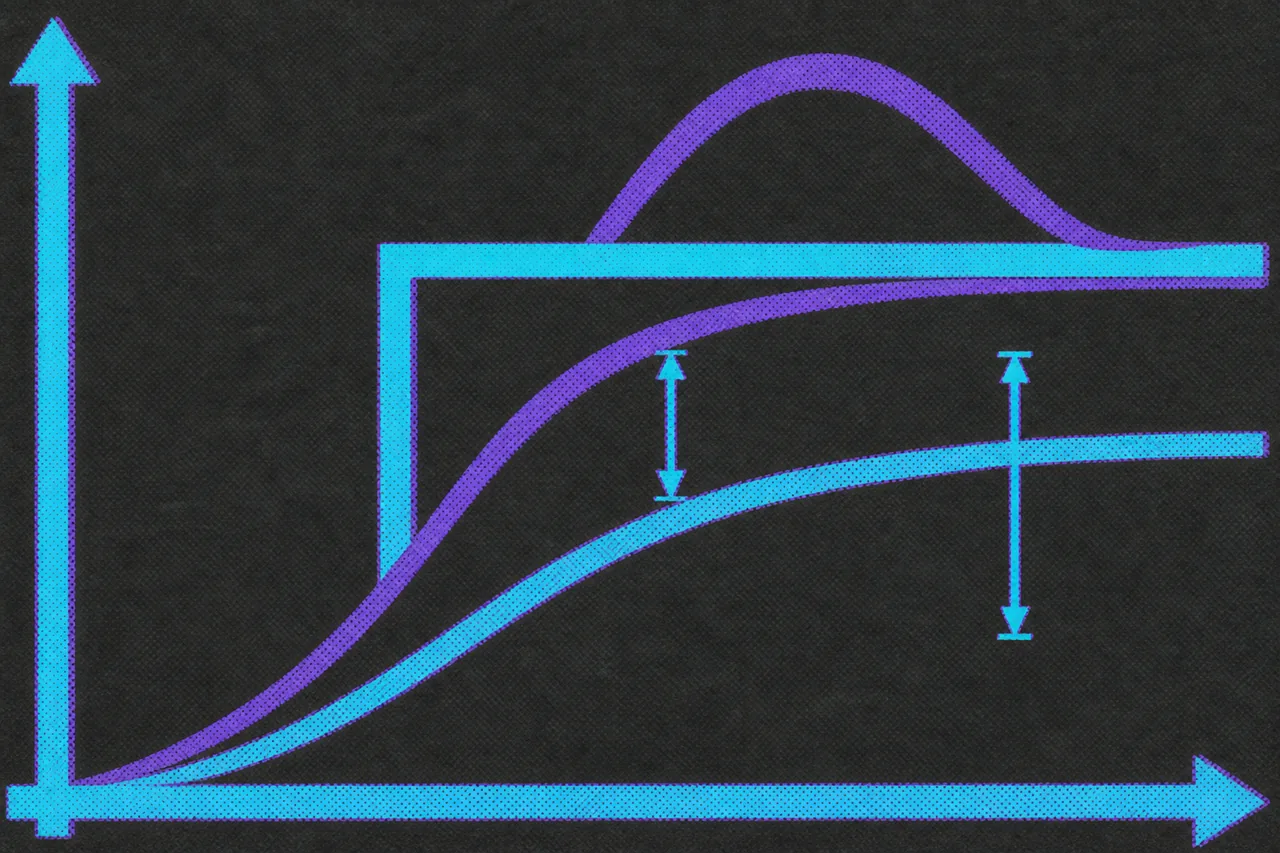
An EWMA lags, and the harder you smooth the further behind it sits. Patrick Mulloy published an answer to that in Technical Analysis of Stocks & Commodities in 1994: measure the lag from data you already have, then subtract it. Two filters came out of the idea, DEMA and TEMA, and both ship in Peptrend’s Advanced Mode.
What are the DEMA and TEMA formulas?
DEMA = 2·EMA₁ − EMA₂. TEMA = 3·EMA₁ − 3·EMA₂ + EMA₃.
EMA₁ is a plain EWMA of your weigh-ins. EMA₂ is an EWMA of EMA₁, the same filter run back over its
own output. EMA₃ is an EWMA of EMA₂. A single α feeds every pass — two of them for DEMA, three for
TEMA — and Peptrend hands them the same ewmaAlpha you set for ordinary EWMA, default 0.1.
Mulloy introduced DEMA in “Smoothing Data With Faster Moving Averages”, volume 12 number 1, January 1994, pages 11–19. TEMA arrives in the follow-up a month later — “Smoothing Data With Less Lag”, volume 12 number 2, pages 72–80 — whose abstract lists DEMA1, TEMA1 and DEMA2 together with the trade-off between smoothing random fluctuation and introducing lag.
The names invite a wrong guess. Smoothing an EWMA a second time gives you EMA₂, which trails EMA₁ by about as much as EMA₁ trails the scale — a slower line, not a faster one. All the speed comes from the subtraction. If you want the plain version of the filter these two are built on, start with what an EWMA actually does to a weigh-in.
How do DEMA and TEMA cut the lag?
Run a filter over its own output and the second pass falls behind the first by roughly as much as
the first fell behind the raw data. So the gap EMA₁ − EMA₂ is an estimate of how far EMA₁ is
trailing. Add it back:
EMA₁ + (EMA₁ − EMA₂) = 2·EMA₁ − EMA₂That is DEMA, in one step. TEMA applies the correction harder and adds a second-order term:
EMA₁ + 2·(EMA₁ − EMA₂) + (EMA₃ − EMA₂) = 3·EMA₁ − 3·EMA₂ + EMA₃The estimate is exact for exactly one shape of data: a straight line. When your weight is falling at a steady rate, an EWMA settles a fixed distance behind the truth, EMA₂ settles the same fixed distance behind EMA₁, and the subtraction cancels the whole thing. Feed it a bend, a spike or a step and the correction is wrong — reliably, and in a direction you can work out in advance.
How fast do they catch up, and how far past do they go?
Feed a clean 1 lb step into all three at α = 0.1, from a line that has already settled, and DEMA runs 12% past the true value while TEMA runs 18% past. Days below are counted from the step.
| Filter | Halfway | 95% of the step | Peak | Back within 1% |
|---|---|---|---|---|
| EWMA | day 6 | day 28 | 1.000 lb, no overshoot | day 43 |
| DEMA | day 3 | day 8 | 1.122 lb on day 18 | day 58 |
| TEMA | day 2 | day 5 | 1.175 lb on day 12 | day 65 |
TEMA covers 95% of the move in a fifth of EWMA’s time, then takes half again as long to stop moving. Bodyweight rarely steps on its own, but the things sitting on top of it do: a travel week, a sodium load, a stomach bug, the first days of a new medication. Each one puts an edge in the series, and these two filters answer every edge with a bump past the mark and a slow walk back. That walk back looks exactly like a plateau if you do not know it is an artefact, which is worth keeping in mind before you go reading a flat stretch as a stall.
Why do older weigh-ins get a negative weight?
Every exponential filter is a weighted sum of past readings, and subtracting EMA₂ drives the far end of that sum below zero. At α = 0.1:
| Age of the weigh-in | EWMA weight | DEMA weight | TEMA weight |
|---|---|---|---|
| today | 0.100 | 0.190 | 0.271 |
| 7 days ago | 0.048 | 0.057 | 0.046 |
| 13 days ago | 0.025 | 0.015 | −0.004 |
| 19 days ago | 0.014 | 0.000 | −0.012 |
| 28 days ago | 0.005 | −0.005 | −0.007 |
DEMA’s weight on a weigh-in exactly 19 days old is zero, and everything older than that subtracts, bottoming out near −0.005 around day 28. TEMA crosses into negative weight at 13 days and troughs at −0.012 on day 19. Summed across the whole tail, DEMA’s negative weights come to −0.12 and TEMA’s to −0.20.
In scale units: a single reading 5 lb above the line moves an EWMA 0.50 lb on the day it lands, DEMA 0.95 lb and TEMA 1.36 lb. Nineteen days later, that same reading is still in the sum, now pulling the TEMA line down by about 0.06 lb.
What do DEMA and TEMA do to 84 real weigh-ins?
On one user’s log — 84 weigh-ins over 225 days — EWMA at α = 0.1 ignores 75.9% of the scale’s daily movement. DEMA, from the same α, ignores 64.7%. TEMA, 54.4%.
| Method | Line moves/day | Scale movement ignored | Final reading |
|---|---|---|---|
| Robust Adaptive EWMA (default) | 0.094 lb | 78.1% | 185.0 lb |
| EWMA | 0.103 lb | 75.9% | 184.5 lb |
| DEMA | 0.152 lb | 64.7% | 183.6 lb |
| TEMA | 0.196 lb | 54.4% | 183.3 lb |
| HMA | 0.368 lb | 14.3% | 182.9 lb |
That log carries a mean day-to-day change of 1.16 lb over an underlying drift of 0.098 lb/day, so the noise runs about 11.9 times the signal — the arithmetic is laid out in signal-to-noise on your scale. Against that ratio, “ignores 54.4%” means TEMA passes close to half of that daily noise straight through into the line it draws. It also finishes 1.2 lb below EWMA, which is what a forward-leaning filter does at the end of a downtrend: it has already priced in a move the slower filters are still catching up to. Whether that is prescience or overshoot depends entirely on what happens next week.
Where are DEMA and TEMA in the app?
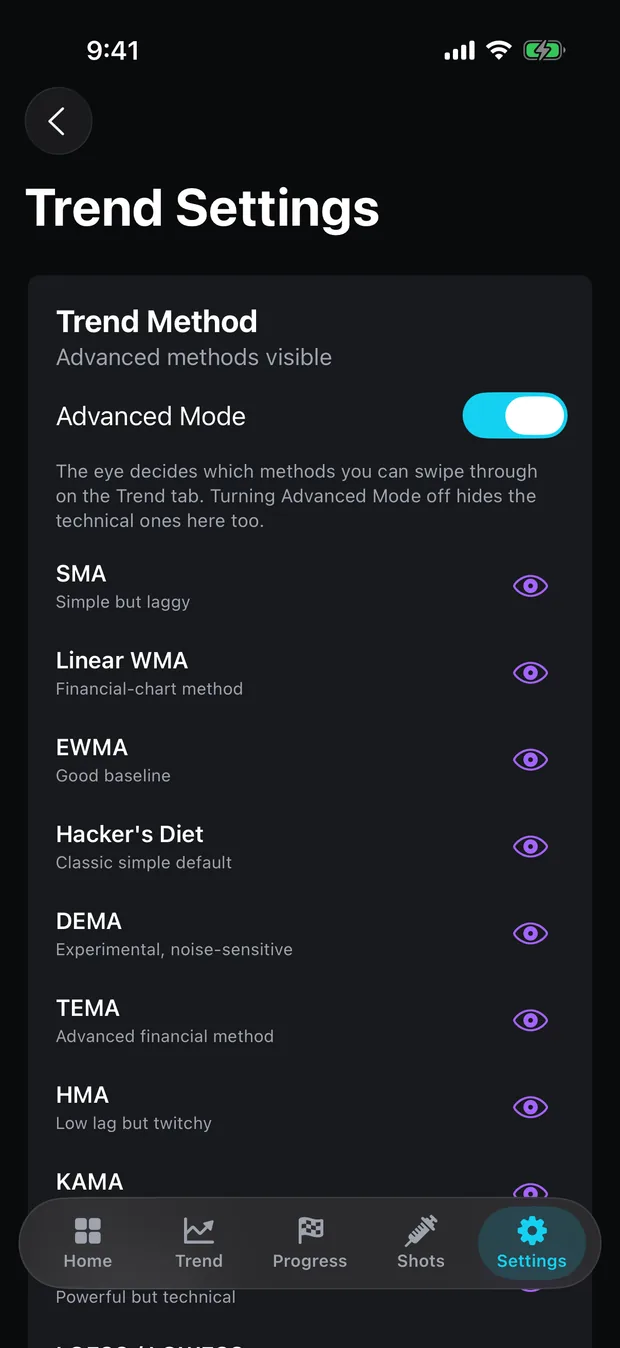
DEMA and TEMA are Advanced Mode methods, which puts them behind Pro along with the trend chart
itself. Both read the same ewmaAlpha slider as plain EWMA. Both interpolate unconditionally: miss
three days and the filter is fed a straight line drawn between the weigh-ins either side. That is a
deliberate split from Hacker’s Diet, which refuses to interpolate at all —
what interpolation does to the line covers why the choice
changes the answer.
The app’s own method card does not oversell them. Tap through to DEMA and the listed cons are “Noise-sensitive” and “Can defeat the purpose of smoothing”. TEMA’s are “Noisy” and “Not recommended as a default”, with a best use case of “Advanced mode experimentation only”. Everything the free tier keeps, and everything it does not, is spelled out in what stays free.
Should you actually use DEMA or TEMA?
Probably not as your everyday line. The case for DEMA is narrow but real: weigh in daily, own a scale you trust, and be in the middle of changing something — a titration, a new training block — where you want the line to admit the change inside a week rather than a month. DEMA gets 95% of a genuine step in 8 days against EWMA’s 28. You pay 0.152 lb of daily line movement instead of 0.103, and a line that sits more than 1% above the new level until day 58.
TEMA is harder to defend on a bathroom scale. Mulloy built it for securities analysis, where a sharp move in the price is a real trade worth chasing. A five-pound jump between two mornings would need a 17,500 kcal swing at the app’s default 3,500 kcal per pound, so a scale that prints one is measuring water. TEMA’s 54.4% rejection rate on a series with nearly 12:1 noise is not much of a filter.
If you want a faster line built on a different mechanism, look at the Kalman filter — it carries a velocity state and lets the gain decide how much to believe each reading, instead of fixing the correction in advance the way 2·EMA₁ − EMA₂ does. Whichever way you go, switch methods with your own data on screen: across the fifteen methods on those same 84 weigh-ins, the final readings disagree by 4.0 lb, from 182.9 to 187.0. The full list, with what each one assumes, is on the methods page, and choosing a trend method walks through picking one.
Common questions
How long does a trend line take to catch up after a real change?
At the app's default α of 0.1, a plain EWMA absorbs 95% of a clean 1 lb step in 28 days and is within 1% of it on day 43. DEMA covers that same 95% in 8 days and TEMA in 5, and both run past the true value before settling back.
Is DEMA better than EWMA for tracking weight?
It responds faster and rejects less. On this user's log, DEMA ignores 64.7% of the scale's daily movement against EWMA's 75.9% at the same α of 0.1, and its line moves 0.152 lb a day instead of 0.103. Faster only helps if your scale is consistent enough to be worth listening to.
Why does my DEMA line overshoot and then come back?
DEMA estimates its own lag as the gap between one smoothing pass and two, and that estimate is exact only for a straight line. After a step the correction is too big. From a settled line, a 1 lb step drives DEMA to 1.12 lb on day 18 before it eases back down.
Who invented DEMA and TEMA?
Patrick G. Mulloy, in Technical Analysis of Stocks & Commodities. DEMA appeared in the January 1994 issue, in 'Smoothing Data With Faster Moving Averages' (pages 11–19); TEMA appeared in the February 1994 follow-up, 'Smoothing Data With Less Lag' (pages 72–80).
Sources
- Mulloy, P.G. — Smoothing Data With Faster Moving Averages, Technical Analysis of Stocks & Commodities V.12:1 (11–19)
- Mulloy, P.G. — Smoothing Data With Less Lag, Technical Analysis of Stocks & Commodities V.12:2 (72–80)
- Double exponential moving average — Wikipedia
- Triple exponential moving average — Wikipedia