
Is a weekly average weight better than a daily weigh-in?
For reading direction, usually yes; for reading today, no. On one user's log, Peptrend's Weekly Average ignored 83.1% of the scale's day-to-day movement, the most of the fifteen methods, and finished on the same 183.0 lb as the log's low. It plots one point per calendar week, so the current week's figure moves with every new reading, and a week with one weigh-in is just that weigh-in.
A weekly average is the simplest smoother there is: add up the week’s weigh-ins and divide. Peptrend offers it as one of fifteen trend methods, and on a fresh install it is one of the three on the method strip. Whether it beats a daily reading depends on the question you are asking of the scale, and one real log puts numbers on both sides.
What does the Weekly Average method compute?
The plain mean of each calendar week’s weigh-ins, plotted at the start of that week. It is the only one of Peptrend’s fifteen methods that skips the daily series entirely: no interpolation across missed days, no smoothing constant, no window to tune. The weekly rate it reports is this week’s mean minus last week’s, already in pounds or kilograms per week.
Three details follow from that definition:
- Week boundaries follow your phone’s region. The app groups by the calendar’s week of the year, so a region whose weeks start on Sunday splits them differently from one that starts on Monday.
- The current week is never finished. Its point is the mean of whatever readings the week holds so far, so it moves with each new weigh-in until the week ends.
- Excluded weigh-ins are left out, and two readings on the same day both count, because the method groups entries rather than days.
How much noise does a weekly mean remove?
More than any other method in the app, on this log. The figures below come from one user’s log, 84 weigh-ins over 225 days, run through each method at the app’s default settings. “Ignored” is the share of the scale’s own day-to-day movement the line does not pass through.
| Method | Line moves per day | Scale movement ignored | Final reading |
|---|---|---|---|
| Weekly Average | 0.196 lb (a week’s step ÷ 7) | 83.1% | 183.0 lb |
| LOESS | 0.074 lb | 82.8% | 184.7 lb |
| Robust Adaptive EWMA | 0.094 lb | 78.1% | 185.0 lb |
| EWMA | 0.103 lb | 75.9% | 184.5 lb |
| SMA | 0.295 lb | 74.7% | 184.7 lb |
| Rolling Median | 0.304 lb | 73.9% | 185.0 lb |
The weekly figure moves once a week, so its “per day” number is a week’s step divided by seven, quoted only to sit on the same scale as the rest. It also finished level with the log’s lowest reading, 183.0 lb, while the daily smoothers finished one to two pounds above it. That is lag in the daily methods as much as accuracy in the weekly one: a line that weights old readings is still carrying some of them.
Why does averaging across a week help?
Because body weight has a weekly rhythm, and a full week of readings covers all of it. Orsama and colleagues, working from 4,657 measurements taken by 80 adults, found weight ran highest on Sunday and Monday and fell toward the end of the week. Turicchi and colleagues saw the same Monday peak and Friday low in a European weight-loss-maintenance trial. A single Monday reading sits at one point in that cycle. A mean of seven readings averages across it.
The other gain is plain arithmetic. Averaging n independent readings divides their random spread by √n, so a week of daily weigh-ins carries far less noise than any one of them. On this log the day-over-day change averaged 1.16 lb of movement, against an underlying drift of 0.098 lb/day.
Where does a weekly average go wrong?
When the week is thin. This log spans 33 calendar weeks. Nine of them have no reading at all, four have exactly one, four have two and sixteen have three or more, up to seven. A week with one weigh-in is that weigh-in, with all of its noise. Across the weeks with two or more readings, the readings inside a week spanned a median of 2.0 lb and as much as 4.2 lb, so a single reading can land anywhere in a band that wide.
The week-to-week steps show it. They averaged 1.37 lb, the largest was 6.0 lb, and 7 of the 23 steps went up across a log that fell overall. Those are large, blocky moves for a line that is meant to be calm.
It also cannot tell you anything about today. The latest point describes a week, and mid-week it describes part of one. If you want the line under this morning’s reading, a daily method answers that and a weekly mean does not. Choosing a trend method sets the fifteen side by side, and interpolation covers how the daily methods fill the days you skip.
When is the weekly average the right choice?
When you weigh in a few times a week rather than daily, and want a figure that does not pretend to more precision than the readings carry. It has no parameters to get wrong and no hidden interpolation, and you can check every point by hand.
When you weigh in daily and want a reading for today, a daily method does more with the same data. The Robust Adaptive EWMA, the app’s default, ignored 78.1% of the movement on this log while still producing a value every day. And when readings are rare, every method struggles: the signal-to-noise post works out how many days of data any line needs before a change shows through.
Is the Weekly Average free?
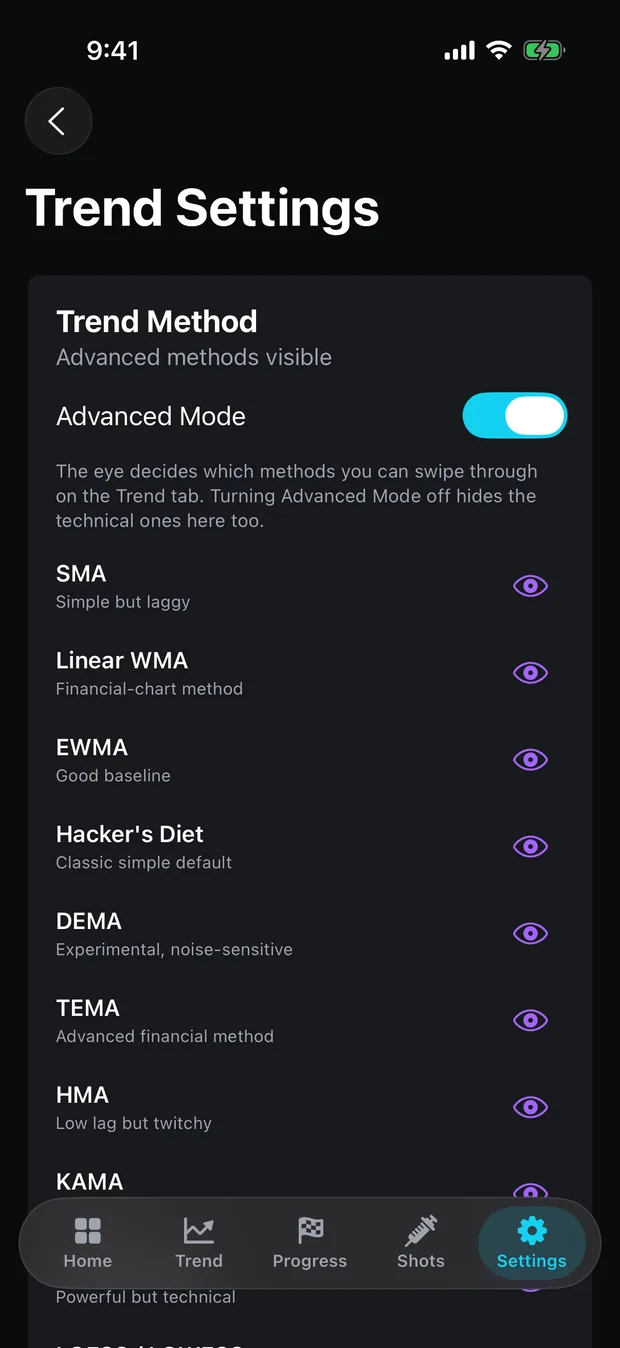
You can choose it on the free tier. It is one of the four Simple Mode methods in Settings, and one of the three a fresh install shows on the strip. The Weight Trend chart that draws it is Pro, as is every smoothed line in the app; the raw weigh-ins and the Scale tab chart are free. The methods page has the formula for this method and the other fourteen.
Common questions
Is a weekly average weight more accurate than a daily weight?
It is less noisy, not more accurate. On one user's log the weekly mean ignored 83.1% of the scale's day-to-day movement, but a week with a single weigh-in carries all of that day's noise, and the figure says nothing about any one day.
How does Peptrend calculate the weekly average?
It groups your included weigh-ins by calendar week, takes their plain mean, and plots it at the start of the week. The weekly rate is this week's mean minus last week's. Week boundaries follow your phone's region settings.
Should I weigh in every day to use a weekly average?
The more readings a week holds, the less any single one can move it. On one user's log a week's readings spanned a median of 2.0 lb, so a week with only one reading can land anywhere in that range.
Sources
- Turicchi et al., Weekly, seasonal and holiday body weight fluctuation patterns among individuals engaged in a European multi-centre behavioural weight loss maintenance intervention, PLOS ONE (2020)
- Orsama et al., 'Weight Rhythms: Weight Increases during Weekends and Decreases during Weekdays', Obesity Facts (2014)
- Hyndman & Athanasopoulos, Forecasting: Principles and Practice (3rd ed.) — Moving averages
- The Scientist and Engineer's Guide to Digital Signal Processing, ch. 15: Moving Average Filters