Switching from semaglutide to tirzepatide: what the dose log shows
Peptrend draws a switch as two lines: semaglutide fading on its 7.0-day half-life, tirzepatide building on 5.0 days. In the app's model, two weeks after the last semaglutide dose it is at half its usual pre-dose level while tirzepatide is at 62% of its own. Every old dose keeps its own numbers. The app logs the switch; the prescriber and the labels decide how to make it.
A move from weekly semaglutide to weekly tirzepatide leaves two drugs in the log for several weeks. Since version 1.5.0 Peptrend draws that as it happens: semaglutide fading on its own half-life while tirzepatide builds on its own. Before 1.5.0 the curve followed one medication name and left the other’s doses out. Everything below is the app’s arithmetic on the doses you log. When to switch and what to start on are decisions for the prescriber, and the app makes neither.
How do you log the switch?
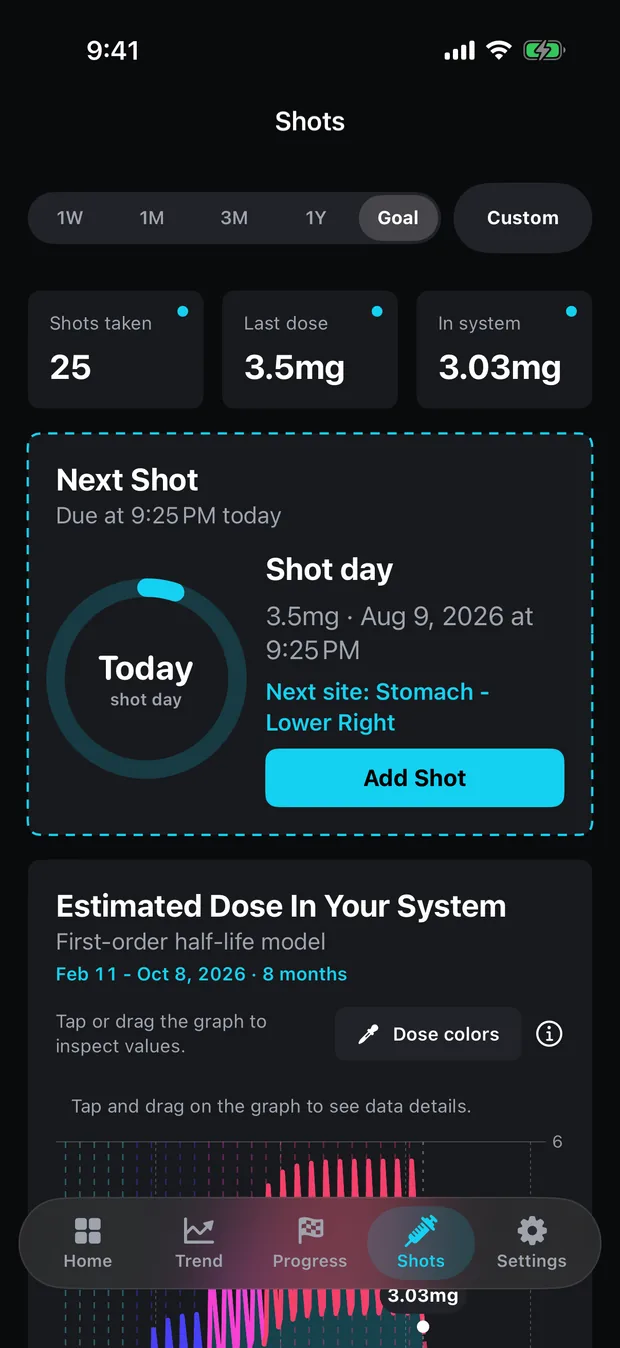
Log the first tirzepatide dose and tell the app it replaces semaglutide. Choose Tirzepatide in the Add sheet’s Medication menu, and because the log has not seen it before, the sheet asks: “Tirzepatide is new here. Are you switching to it?” Pick Switching to it and tirzepatide becomes the main medication. New doses start as tirzepatide, and your semaglutide doses “stay on every chart while it clears.”
The same move is in Settings › Medication › Change Main Medication. Its confirmation screen says what will happen before anything does: new doses start as the new medication, and your semaglutide doses keep semaglutide’s half-life and stay on every chart. A toggle, “I’m still taking Semaglutide too”, decides whether the old medication is marked stopped or kept on the Next card with its own schedule.
Brands fold into their generic. Doses logged or imported as Ozempic or Wegovy count as semaglutide, and Mounjaro or Zepbound doses count as tirzepatide, so a history with mixed names still draws one line per drug.
What does the chart draw after a switch?
Two lines, one per drug, never added. The table runs the app’s own model through a switch: steady weekly semaglutide injections at the app’s semaglutide settings (7.0-day half-life, 48 hours to peak), then weekly tirzepatide at its settings (5.0-day half-life, 24 hours to peak) starting a week after the last semaglutide dose. Each column is a share of that drug’s own usual pre-dose level once it is fully built up, read just before each weekly dose. Doses are left out on purpose, so no row says anything about how much of either to take.
| Weeks after last semaglutide dose | Semaglutide, share of its usual pre-dose level | Tirzepatide, share of its eventual pre-dose level |
|---|---|---|
| 1 | 100% | 0%, first dose due |
| 2 | 50.0% | 62.1% |
| 3 | 25.0% | 85.6% |
| 4 | 12.5% | 94.6% |
| 5 | 6.3% | 97.9% |
| 6 | 3.1% | 99.2% |
| 8 | 0.8% | 99.9% |
Semaglutide halves every week because its half-life in the app equals the dosing interval. It falls below a tenth of its usual pre-dose level about 30 days after the last dose. Tirzepatide’s shorter half-life brings it near its plateau sooner: 95% of the way by its fourth dose. Both columns are modelled milligram amounts. Neither is a blood level, and a drug with half its usual milligrams in the model is not “half as effective”; the model says nothing about effect at all.
Why two lines instead of one total?
Because milligrams of two drugs do not add. Two milligrams of semaglutide plus two of tirzepatide is not four milligrams of anything, so a summed curve would be a number with no meaning. The readout under the chart names each line separately.
The old line leaves the chart once it has cleared: nothing in the visible window or its projection reaches 1% of semaglutide’s own largest logged dose. After steady weekly doses of one size, the modelled semaglutide amount falls under that mark about 54 days after the last dose, but the test is applied to the window on screen, so a longer range keeps the line in view for longer. Until then a chart covering the switch shows the hand-off, and the semaglutide history stays in the Dose Log for good.
When does the app say the first tirzepatide dose is due?
When the next semaglutide dose would have been, unless you log something else. Straight after a switch nothing has been logged as tirzepatide, so the Next card takes its timing from the last dose you did log, and the new medication’s interval. It does not borrow the old drug’s amount: the reminder for that first dose reads “Your first Tirzepatide shot is due today” instead of quoting a semaglutide figure. Once a tirzepatide dose is logged, its own date and amount take over.
That date is arithmetic on the log. The prescribing information and the prescriber set the actual timing of a switch, and if it differs, logging the dose at its real time moves every date after it.
What else changes on the charts?
Home’s In Your System card and the dose-in-system shading on weight charts follow the main medication, so after the switch they show tirzepatide. The dose markers on the weight chart show every taken dose of both drugs.
One thing to watch: with dose colours on, colour comes from milligrams alone. The ramp runs from your lowest logged dose to your highest across the whole history, whatever the drug, so a tirzepatide dose with more milligrams is shaded as heavier than a semaglutide dose with fewer. That is a statement about milligrams and nothing else. How to chart a titration explains the ramp.
What does the model not capture?
Everything personal. The constants are published averages: the semaglutide label gives an elimination half-life of about one week and the tirzepatide label about five days, and nobody’s blood work has checked the app’s curve. The model knows nothing about tolerability, side effects, or why a switch was made, and it does not compare the two drugs in any way.
It also cannot tell a switch from a pause. If you answer Taking both by mistake, or switch back, Settings › Medication lets you change the main medication again; every dose keeps its own medication and numbers whichever way you go. Tracking two medications at once covers the general case, steady state explains why four to five half-lives keep coming up, and the free tier covers what needs Pro. None of the switching features does.
Common questions
How do I log a switch from semaglutide to tirzepatide in Peptrend?
Choose Tirzepatide in the Medication menu when you add the first dose and answer Switching to it, or use Change Main Medication in Settings › Medication. Every semaglutide dose already logged keeps semaglutide's half-life and stays on the charts.
How long does semaglutide stay on the chart after the last dose?
In the app's model, at a 7.0-day half-life, the semaglutide line falls below a tenth of its usual pre-dose level about 30 days after the last dose. It leaves the chart once nothing in view reaches 1% of its largest dose.
Does Peptrend tell me what tirzepatide dose to start on?
No. The app logs what you take and draws estimates from it. The starting dose and the timing of a switch come from the prescriber and the prescribing information.
Is the In Your System figure after a switch a blood level?
No. Each line is a decayed milligram estimate from a published half-life. The model has no volume of distribution, so it cannot produce a concentration, and it never adds the two drugs together.
Sources
- OZEMPIC (semaglutide) injection — prescribing information, section 12.3, DailyMed
- MOUNJARO (tirzepatide) injection — prescribing information, section 12.3, DailyMed
- Hallare J, Gerriets V. Elimination Half-Life of Drugs. StatPearls, NCBI Bookshelf
- Wadhwa RR, Cascella M. Steady State Concentration. StatPearls, NCBI Bookshelf