Liraglutide half-life, time to peak and level curve
Liraglutide has an elimination half-life of about 13 hours, and its FDA label puts the peak 8 to 12 hours after an injection. Peptrend's preset uses 0.55 days, which is 13.2 hours, and a 10-hour peak. In the app's model one dose climbs to 59.1% of the logged amount at 10 hours, and 38.6% is left when the next daily dose is due. Repeated daily, the level settles within 2.2 to 2.75 days, between 95.1% and 54.8% of one dose.
The preset's numbers, beside its source
What the Liraglutide preset writes into Settings › Medication, beside what the FDA label says. The sources at the foot of the page name what the app itself cites.
| Constant | Peptrend preset | FDA label |
|---|---|---|
| Half-life | 13.2 hours | Approximately 13 hours |
| Time to peak (Tmax) | 10 hours | 8 to 12 hours after a dose |
| Bioavailability | 100%, every logged milligram | Approximately 55% |
| Dosing interval | Every day | Once daily |
| Time to steady state | 2.2 to 2.75 days (4 to 5 half-lives) | Not stated in section 12.3 |
The curve the model draws
Both curves are Peptrend's own model run on the four numbers above and scaled to one logged dose, so they carry no dose amount. Each point is a decayed-milligram estimate built from a published half-life and time to peak. The model has no volume of distribution, so it cannot give a blood or plasma concentration. The curves describe liraglutide as this preset models it, and describe no effect of the app and no person's result.
| Model quantity | Value for this preset |
|---|---|
| Elimination rate, ke = ln 2 ÷ half-life | 1.2603 per day |
| Absorption rate, ka, solved from Tmax | 4.08 per day |
| One dose at its peak | 59.1% of the logged dose, at 10 hours |
| One dose, one interval later | 38.6% of the logged dose |
| Accumulation ratio, 1 ÷ (1 − e^(−ke·τ)) | 1.40× |
| Settled peak and trough | 95.1% and 54.8% of one logged dose |
What does the label say about liraglutide’s half-life and peak?
Liraglutide, sold as Victoza and Saxenda, clears far faster than the weekly medications. The prescribing information Peptrend cites gives an elimination half-life of approximately 13 hours, puts maximum concentration 8 to 12 hours after a subcutaneous dose, and reports an absolute bioavailability of approximately 55%. The label doses it once a day, and its pharmacokinetics section gives no time to steady state.
The preset stores the half-life as 0.55 days, which is 13.2 hours rather than 13. The half-life stepper widens its step as the value grows, and 0.55 is a value it lands on; the 12-minute difference is small beside the spread between people. The app labels it 13 hours. The 10-hour peak is the middle of the label’s window, and the interval is one day.
What does one dose look like in the model?
One dose climbs for 10 hours and turns over at 59.1% of the logged amount, the lowest peak of the four injection presets. The reason is the ratio: a 10-hour climb is three-quarters of a 13.2-hour half-life, so elimination takes a large share before the peak arrives.
The model also sets a hard limit here. It cannot place a peak later than 1.44 half-lives after the dose, which is about 19 hours at this half-life, and the label’s 12-hour upper end sits inside it. Reading the absorption curve explains where that ceiling comes from.
The day between doses is 1.8 half-lives long, so most of each dose is gone before the next: 38.6% is left when the next daily injection is due.
What happens when daily doses repeat?
Liraglutide settles faster than any other preset. Four to five half-lives is 2.2 to 2.75 days, and three days in, the level just before each injection is within 3% of where it settles. Settled, it swings between 95.1% of one logged dose at its highest and 54.8% just before the next injection.
The settled peak never reaches a full dose’s worth. With about 72% of the level clearing each day, the model builds to only about 1.4 times what a single dose leaves after a day. The label states no time to steady state, so the four-to-five-half-life rule is the only estimate on this page, and it comes from the model. How long a GLP-1 takes to reach steady state sets out that rule.
Where does the model part from the label?
- Bioavailability. The label reports approximately 55% and the model uses 100%, which puts the curve about 1.8 times as high as the label’s figure would. The shape is unchanged.
- Timing. With a 13-hour half-life, the hour of each injection matters: an hour is nearly 8% of a half-life. The app keeps each dose’s time as well as its date, and the model uses both.
- The app’s own chart. On the 1-week and 1-month ranges the app computes the curve every 6 hours. On longer ranges it samples once a day or less often, which is coarser than liraglutide’s own daily rise and fall, so those ranges miss most of the daily peaks and troughs.
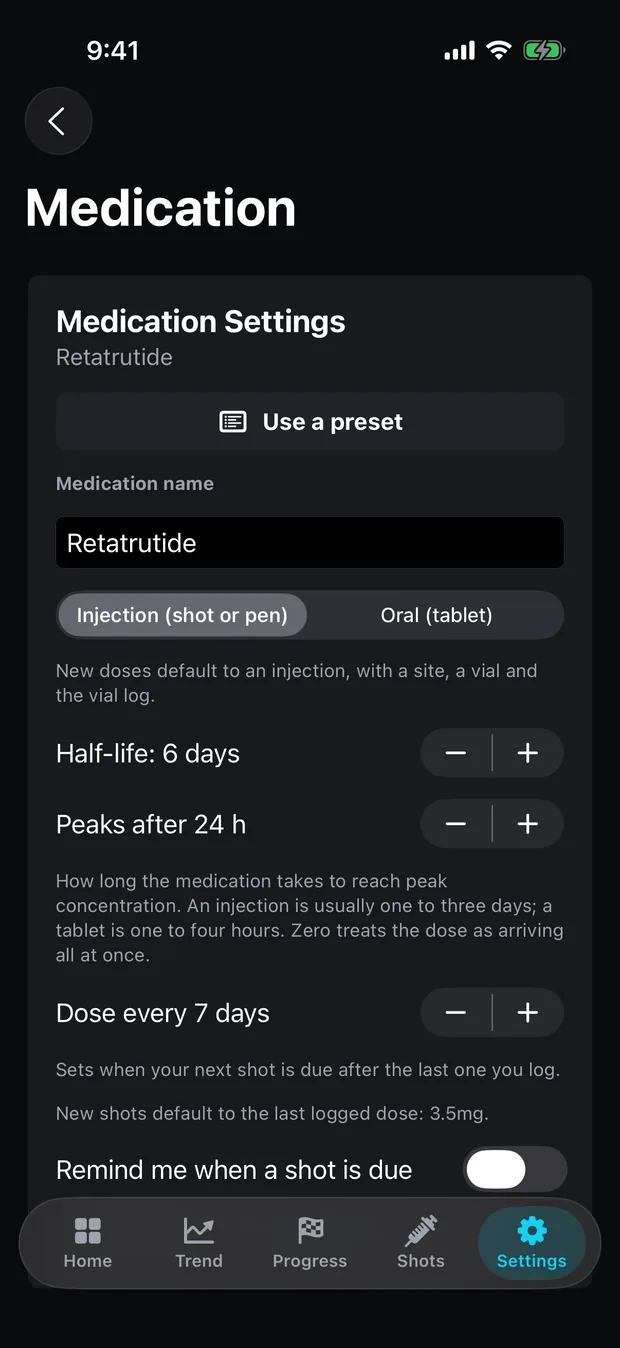
Every constant is editable in Settings › Medication, and the app asks before a preset overwrites them.
How Peptrend logs liraglutide
With the Liraglutide preset applied from Use a preset in Settings › Medication, each shot logged on the Shots tab carries a date and time and a dose in milligrams, with the injection site, vial and pain score optional. The model above runs over every taken dose logged under the name Liraglutide.
The arithmetic behind these curves
- How long until a GLP-1 reaches steady state? Four to five half-lives
- When does a GLP-1 peak after injection? Tmax and the absorption curve
- Does oral semaglutide have the same half-life as the injection?
- Every medication preset, side by side
Other presets: Semaglutide (injection) · Semaglutide (tablet) · Tirzepatide · Dulaglutide · Orforglipron
Sources
- VICTOZA (liraglutide) injection — prescribing information, section 12.3 (revised 10/2025), DailyMed — FDA label, cited in the app
- Min JS et al. A Comprehensive Review on the Pharmacokinetics and Drug-Drug Interactions of Approved GLP-1 Receptor Agonists and a Dual GLP-1/GIP Receptor Agonist. Drug Design, Development and Therapy, 2025 — Review, cited in the app
- Garrett ER. The Bateman function revisited. Journal of Pharmacokinetics and Biopharmaceutics, 1994