Oral semaglutide half-life, time to peak and level curve
Oral semaglutide has an elimination half-life of about one week, like the injection, but its FDA label puts the peak about an hour after the tablet and absorption at roughly 0.4% to 1% for the original tablets. Peptrend's preset uses 6.5 days, 1.5 hours and 0.8%. In the app's model one tablet peaks at 0.79% of its milligrams, and 0.72% is left a day later. Taken daily, the level settles within 26 to 32.5 days, rippling between 7.9% and 7.1% of one tablet.
The preset's numbers, beside its source
What the Semaglutide (tablet) preset writes into Settings › Medication, beside what the FDA label says. The sources at the foot of the page name what the app itself cites.
| Constant | Peptrend preset | FDA label |
|---|---|---|
| Half-life | 6.5 days | Approximately one week |
| Time to peak (Tmax) | 1.5 hours | About 1 hour after the tablet |
| Bioavailability | 0.8% of each dose | About 0.4% to 1% for the original tablets, 1% to 2% for the newer ones |
| Dosing interval | Every day | Once daily |
| Time to steady state | 26 to 32.5 days (4 to 5 half-lives) | After 4 to 5 weeks of daily dosing |
The curve the model draws
Both curves are Peptrend's own model run on the four numbers above and scaled to one logged dose, so they carry no dose amount. Each point is a decayed-milligram estimate built from a published half-life and time to peak. The model has no volume of distribution, so it cannot give a blood or plasma concentration. The curves describe oral semaglutide as this preset models it, and describe no effect of the app and no person's result.
| Model quantity | Value for this preset |
|---|---|
| Elimination rate, ke = ln 2 ÷ half-life | 0.1066 per day |
| Absorption rate, ka, solved from Tmax | 111.32 per day |
| One dose at its peak | 0.79% of the logged dose, at 1.5 hours |
| One dose, one interval later | 0.72% of the logged dose |
| Accumulation ratio, 1 ÷ (1 − e^(−ke·τ)) | 9.89× |
| Settled peak and trough | 7.9% and 7.1% of one logged dose |
What does the label say about oral semaglutide’s half-life and peak?
Semaglutide tablets, sold as Rybelsus, carry the same molecule as the injection and the same elimination half-life: approximately one week, by the prescribing information Peptrend cites. What changes is the route. The label puts maximum concentration about an hour after the tablet, estimates absolute bioavailability at about 0.4% to 1%, and reports steady-state exposure after 4 to 5 weeks of daily use.
The preset reads a little finer than the label. Its 6.5-day half-life and 1.5-hour peak match a multiple-dose study in healthy subjects that reported a mean terminal half-life of 153 to 161 hours and a median time to peak of 1 to 2 hours; 6.5 days is 156 hours, inside that range. Its 0.8% is the bioavailability a population model of the clinical pharmacology trials estimated for the dosing conditions on the label, which the paper gives as at least 30 minutes of fasting after the tablet and no more than 120 mL of water. Those trials also covered other conditions, and the estimate moved with them.
What does one tablet look like in the model?
A tablet enters the model at 0.8% of its printed milligrams, so the whole curve stays under 1% of the tablet. It rises within hours, peaks at 0.79% of the tablet’s milligrams, and falls at the week-long half-life, leaving 0.72% when the next day’s tablet is due.
Measured against what was absorbed, that peak is 99.3%, the highest of the six presets. A 1.5-hour climb costs almost nothing against a 6.5-day decay. The absorption rate the app solves from 1.5 hours is about 111 per day, close to arriving all at once, and on the single-dose chart the rise is a near-vertical line at the left edge.
What happens when tablets repeat daily?
Daily tablets stack for weeks, because each day clears only about a tenth of the level. The interval is 0.15 half-lives, so the model builds to nearly ten times what one tablet leaves after a day before it settles. Settled, it ripples between 7.9% and 7.1% of one tablet’s milligrams, a daily peak about 11% above the trough.
The half-life sets the climb, and the interval never enters it. Four to five half-lives is 26 to 32.5 days here, close to the label’s 4 to 5 weeks and close to the weekly injection’s 28 to 35 days. A daily tablet and a weekly injection of the same drug reach a plateau on nearly the same clock. What the interval changes is the shape at the top: a ripple for the tablet, a deep weekly sawtooth for the injection. How long a GLP-1 takes to reach steady state works through the same build-up.
Why is the tablet curve the least certain of the six?
Absorption is the soft number. The population model behind 0.8% found within-subject variability in bioavailability of 137%, and put bioavailability higher with a longer fast after the tablet, levelling off near 1.4% at two hours. The label reports the same rise with a longer fast, and lower absorption with 240 mL of water than with 50 mL. One tablet can deliver far more or far less than the next, and the model applies 0.8% to every one of them.
The same study found the variation much smaller at steady state, 33% within-subject variability in steady-state exposure, because daily dosing and a long half-life average many tablets together. The settled ripple on the chart is the model’s version of that averaging.
The current label also lists a second, newer tablet formulation, with an estimated absolute bioavailability of about 1% to 2%. The preset’s 0.8% belongs to the original tablets. The Absorbed stepper accepts any value from 0.1% to 100%, and the app asks before a preset overwrites it.
Both semaglutide presets write the medication name Semaglutide, and each logged dose keeps its own route, so a switch from the pen to the tablet stays one curve. With the tablet preset applied, earlier injections still count whole and each tablet counts at 0.8%.
How Peptrend logs oral semaglutide
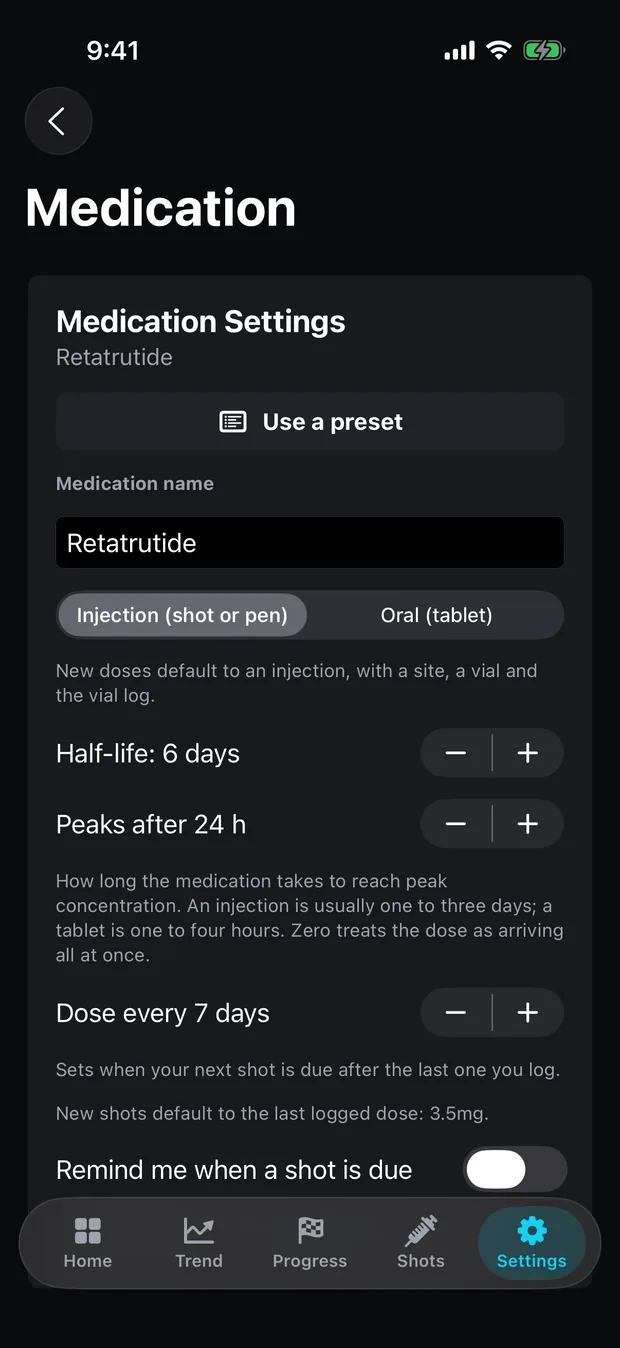
With the Semaglutide (tablet) preset applied from Use a preset in Settings › Medication, the Shots tab becomes a Doses tab. Each tablet logged there carries a date and time and its milligrams, with no site, vial or pain score. The model counts 0.8% of those milligrams, and it runs over every taken dose logged under the name Semaglutide.
The arithmetic behind these curves
- How long until a GLP-1 reaches steady state? Four to five half-lives
- When does a GLP-1 peak after injection? Tmax and the absorption curve
- Does oral semaglutide have the same half-life as the injection?
- Every medication preset, side by side
Other presets: Semaglutide (injection) · Tirzepatide · Dulaglutide · Liraglutide · Orforglipron
Sources
- RYBELSUS (semaglutide) tablets — prescribing information, section 12.3 (revised 1/2026), DailyMed — FDA label, cited in the app
- Overgaard RV et al. Clinical Pharmacokinetics of Oral Semaglutide: Analyses of Data from Clinical Pharmacology Trials. Clinical Pharmacokinetics, 2021 — Pharmacokinetics paper, cited in the app
- Min JS et al. A Comprehensive Review on the Pharmacokinetics and Drug-Drug Interactions of Approved GLP-1 Receptor Agonists and a Dual GLP-1/GIP Receptor Agonist. Drug Design, Development and Therapy, 2025 — Review, cited in the app
- Novo Nordisk. PIONEER 1 trial protocol (NN9924-4233), section 3.1.5.1, ClinicalTrials.gov NCT02906930
- Wadhwa RR, Cascella M. Steady State Concentration. StatPearls, NCBI Bookshelf