Orforglipron half-life, time to peak and level curve
Orforglipron's FDA label gives an elimination half-life of about 29 to 49 hours and a peak 4 to 8 hours after the tablet. The preset in Peptrend 1.4.0 takes the midpoint of each — 1.6 days and 6 hours — with the label's 77% absorbed. In the app's model one tablet peaks at 69.1% of its milligrams, and 51.5% is left a day later. Taken daily, the level settles within 6.4 to 8 days, between 203.0% and 146.4% of one tablet.
The preset's numbers, beside its source
What the Orforglipron preset writes into Settings › Medication, beside what the FDA label says. The sources at the foot of the page name what the app itself cites.
| Constant | Peptrend preset | FDA label |
|---|---|---|
| Half-life | 38.4 hours | Approximately 29 to 49 hours after an oral dose |
| Time to peak (Tmax) | 6 hours | 4 to 8 hours after a dose |
| Bioavailability | 77% of each dose | 77% (geometric mean, absolute) |
| Dosing interval | Every day | Once daily |
| Time to steady state | 6.4 to 8 days (4 to 5 half-lives) | After about 1 week of once-daily dosing |
The curve the model draws
Both curves are Peptrend's own model run on the four numbers above and scaled to one logged dose, so they carry no dose amount. Each point is a decayed-milligram estimate built from a published half-life and time to peak. The model has no volume of distribution, so it cannot give a blood or plasma concentration. The curves describe orforglipron as this preset models it, and describe no effect of the app and no person's result.
| Model quantity | Value for this preset |
|---|---|
| Elimination rate, ke = ln 2 ÷ half-life | 0.4332 per day |
| Absorption rate, ka, solved from Tmax | 14.47 per day |
| One dose at its peak | 69.1% of the logged dose, at 6 hours |
| One dose, one interval later | 51.5% of the logged dose |
| Accumulation ratio, 1 ÷ (1 − e^(−ke·τ)) | 2.84× |
| Settled peak and trough | 203.0% and 146.4% of one logged dose |
What does the label say about orforglipron’s half-life and peak?
Orforglipron is a non-peptide GLP-1 receptor agonist taken as a daily tablet, sold as Foundayo, with an initial US approval in 2026. Its prescribing information gives an elimination half-life of approximately 29 to 49 hours after an oral dose and puts maximum concentration 4 to 8 hours after the dose. It reports a geometric mean absolute bioavailability of 77%, measured at the 0.8 mg dose, with no clinically relevant food effect, and steady-state exposure after about a week of once-daily use.
That label is what Peptrend cites for orforglipron from 1.4.0 on, and the preset is built from it. The table above sets the two side by side.
Where do the preset’s numbers come from?
Each one is a single value standing in for a label range. The model needs one half-life and one time to peak, and the label names no typical figure for either, so the preset takes the midpoint: 1.6 days, which is 38.4 hours, for the 29-to-49-hour half-life, and 6 hours for the 4-to-8-hour peak. The 77% is the label’s own geometric mean, so only that one is quoted rather than derived.
A midpoint is a choice, and the range around it is wide. The label’s 29 hours and its 49 hours differ by a factor of 1.7, and the preset’s 1.6 days sits in the middle of that spread rather than at any measured person’s value. A dedicated disposition study reported a mean absolute oral bioavailability of 79.1% ± 16.8% in 10 healthy participants, which brackets the label’s 77% and shows how much of the spread one number hides. The curve on this page is the middle of the label’s range, not a value measured in anyone.
What does one tablet look like in the model?
On the preset’s numbers, one tablet enters the model at 77% of its milligrams, climbs for 6 hours and peaks at 69.1% of what was swallowed. It then falls at a 38.4-hour half-life, leaving 51.5% when the next day’s tablet is due.
The peak is 89.7% of what the model let in, so the 6-hour climb costs about a tenth of the tablet before the curve turns over. Drawing the tablet as instantaneous instead would put the peak at the full 77% and at the moment of the dose, which is not the shape the label’s 4-to-8-hour Tmax describes.
What happens when tablets repeat daily?
The level settles within four to five half-lives, 6.4 to 8 days, between 203.0% of one tablet’s milligrams at its highest and 146.4% just before the next. A day is 0.63 half-lives, so each tablet lands on about half of the one before, and the model builds to roughly 3.9 times what a single tablet leaves after a day. The settled peak sits about 39% above the settled trough, so the daily teeth stay visible on the chart.
The label’s own steady-state figure is about a week, and the preset agrees with it. Four to five of the label’s 29-to-49-hour half-lives is 4.8 to 10.2 days, and the preset’s 6.4 to 8 days sits inside that. How long a GLP-1 takes to reach steady state explains the four-to-five-half-life rule.
What did the preset use before 1.4.0?
Versions through 1.3.3 built the orforglipron preset from a phase 1a study, because the drug had no label yet: 2.3 days, 55 hours, for the half-life, 3 hours to peak, and 35% absorbed. That study dosed healthy participants and reported a mean half-life of 24.6 to 35.3 hours after a single dose, rising to 48.1 to 67.5 hours after 28 days of daily dosing, and reported neither a time to peak nor a bioavailability.
All three numbers moved once the label existed. The half-life dropped from 55 hours to 38.4, the peak moved from 3 hours to 6, and the absorbed fraction rose from 35% to 77%, so every tablet now counts 2.2 times as much in the model as it did. A curve drawn under the older preset is not comparable with one drawn under 1.4.0, and nothing in the app rescales a history that was logged before the change. The level curve is a decayed-milligram estimate either way, never a blood or plasma concentration.
Can the preset be changed by hand?
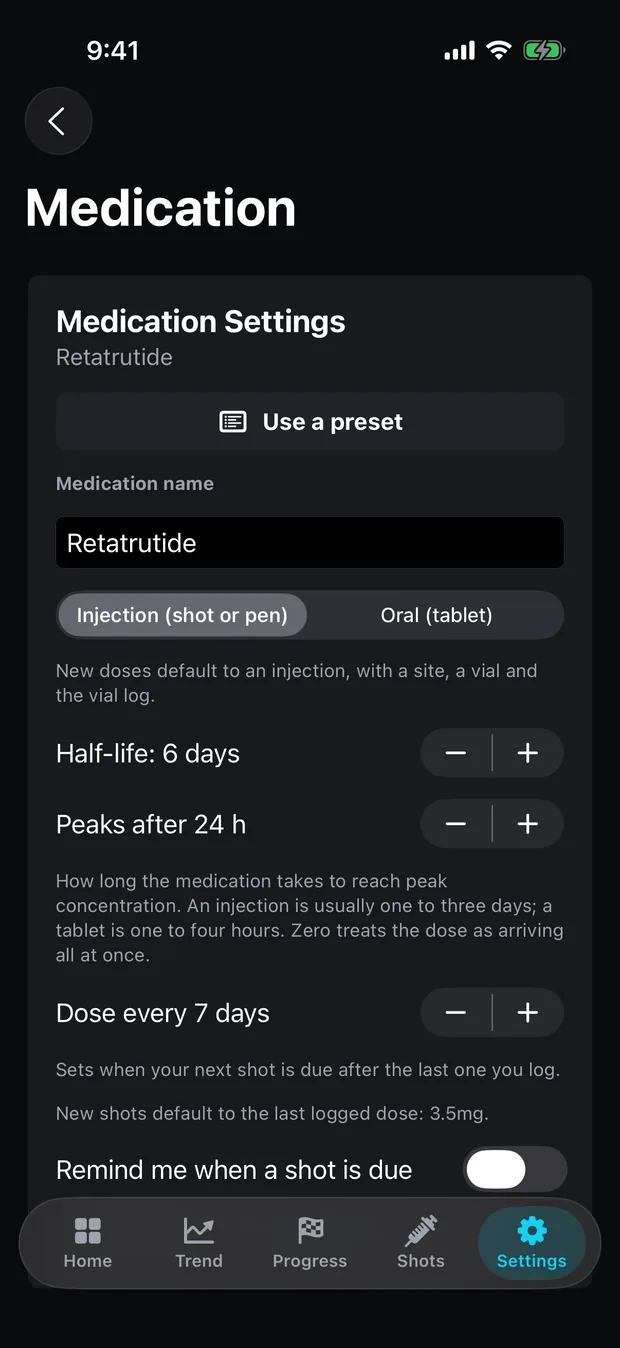
Yes. Every constant is editable in Settings › Medication: the half-life, the time to peak, the absorbed percentage and the interval. The app asks before a preset overwrites them, so values entered by hand stay until a preset is chosen again. Someone who would rather see the ends of the label’s range than its middle can dial the half-life to 29 or 49 hours and watch the plateau move. Reading the absorption curve shows how each of those numbers shapes the curve.
How Peptrend logs orforglipron
With the Orforglipron preset applied from Use a preset in Settings › Medication, the Shots tab becomes a Doses tab. Each tablet logged there carries a date and time and its milligrams, with no site, vial or pain score. In 1.4.0 the model counts 77% of those milligrams, and it runs over every taken dose logged under the name Orforglipron.
The arithmetic behind these curves
- How long until a GLP-1 reaches steady state? Four to five half-lives
- When does a GLP-1 peak after injection? Tmax and the absorption curve
- Does oral semaglutide have the same half-life as the injection?
- Every medication preset, side by side
Other presets: Semaglutide (injection) · Semaglutide (tablet) · Tirzepatide · Dulaglutide · Liraglutide
Sources
- FOUNDAYO (orforglipron) tablets — prescribing information, section 12.3 (revised 7/2026), DailyMed — FDA label, cited in the app
- FOUNDAYO (orforglipron) tablets — prescribing information, section 12.3 (revised 7/2026), DailyMed
- Morse BL et al. Disposition and Absolute Bioavailability of Orally Administered Orforglipron in Healthy Participants. Clinical Pharmacology in Drug Development, 2026
- Pratt E et al. Orforglipron (LY3502970), a novel, oral non-peptide glucagon-like peptide-1 receptor agonist: a Phase 1a, blinded, placebo-controlled, randomized, single- and multiple-ascending-dose study in healthy participants. Diabetes, Obesity and Metabolism, 2023