Does Happy Scale log GLP-1 doses? Happy Scale vs Peptrend
Happy Scale does not advertise injection or dose logging — a keyword scan of its App Store description on 18 September 2026 found no hits for injection, dose, GLP-1, vial or reconstitution. It names four smoothing methods and does not publish the formula behind its recommended default. Peptrend runs fifteen published methods and keeps a dose log and a vial log beside the same weight line.
What is Happy Scale, and what is Peptrend?
Happy Scale is a weight-trend tracker. Front Pocket Software LLC ships it for iPhone and iPad on iOS 16 and for Apple-silicon Macs on macOS 14; on 18 September 2026 its US App Store metadata returned 4.89 stars from 57,931 ratings, last updated 14 September 2026. It is Apple-only — no Google Play listing exists. A keyword scan of its complete App Store description that day returned nothing for injection, dose, medication, GLP-1, peptide, vial or reconstitution.
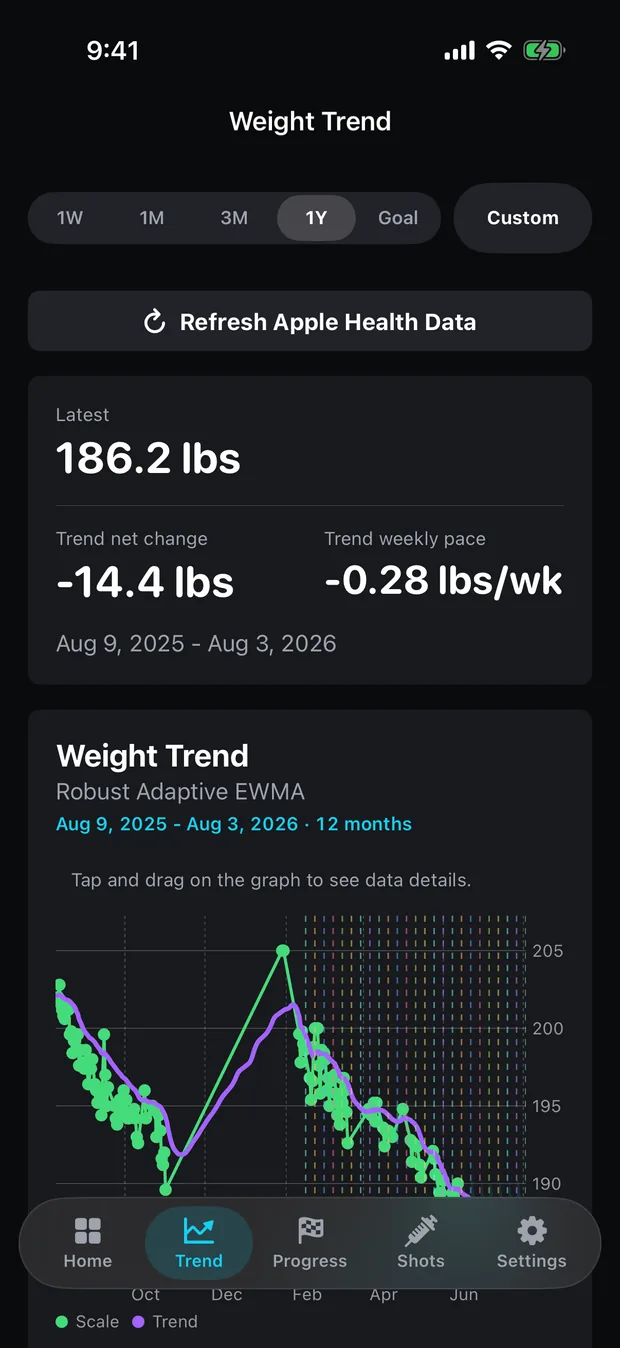
Peptrend runs the same kind of filter over the same kind of data and keeps a dose log next to it. Doses are recorded in milligrams with a date and time, an injection site, a route, a taken flag, an optional 0–10 pain rating and a link to the vial they came from. The trend chart and the dose chart read from one database, so a titration ramp and a weight line sit on the same screen.
That is the structural difference, and it runs in one direction only. Happy Scale does trend maths and does not advertise injection logging. Peptrend does both. The second column is mostly dose-log machinery, and only some of it applies to a weight-only user.
| Happy Scale | Peptrend | |
|---|---|---|
| What it is | weight-trend tracker | weight-trend tracker plus dose log |
| Smoothing methods offered by name | 4 | 15 |
| Recommended default | Happy Scale Smoothing | Robust Adaptive EWMA |
| Default’s formula published | no — behaviour described, algorithm not disclosed | yes — printed in-app and on the method list |
| Injection or dose logging | not advertised | mg, time, site, route, taken, pain, vial |
| Reconstitution maths | not advertised | vial strength ÷ water = mg/mL |
| Apple Health | imports weights, exports all weights back | imports body mass, writes back the weigh-ins you typed if you allow it |
| Platforms | iPhone, iPad, Mac (macOS 14, Apple silicon) | iPhone, iPad (iOS 17) |
| US App Store rating, 18 Sep 2026 | 4.89 from 57,931 ratings | — |
What algorithm does Happy Scale use?
Happy Scale names its four: Happy Scale Smoothing, Double Exponential Smoothing, Exponential Smoothing, and Seven Day Moving Average.
Its support page describes the behaviour of each option and does not publish the formula behind Happy Scale Smoothing, the one it recommends. It cites no lineage either: John Walker and The Hacker’s Diet appear nowhere on it, so nobody should attribute his 1990s smoothing constant to Happy Scale’s default.
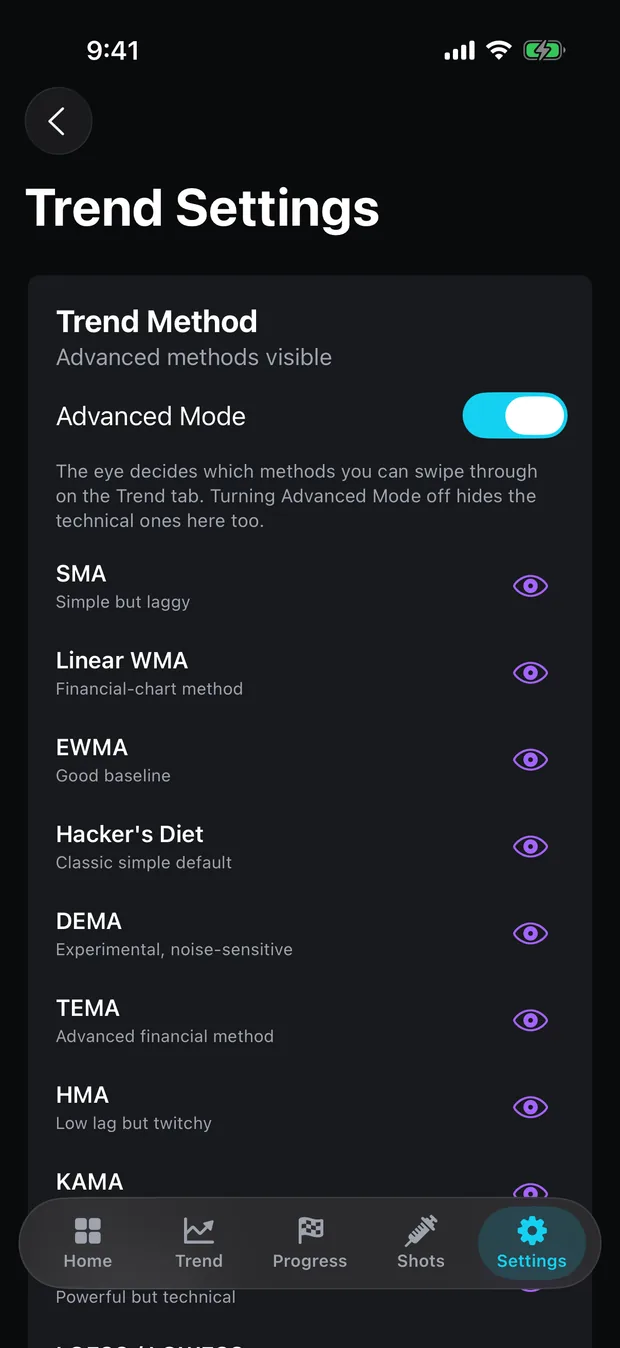
Peptrend offers fifteen methods and gives each one its own sheet in the app — formula, behaviour, pros, cons. Plain EWMA is T_t = α·W_t + (1 − α)·T_t-1 with α editable and 0.1 to start. The default, Robust Adaptive EWMA, stacks three mechanisms: an efficiency ratio that moves α between 0.04 and 0.22 depending on how directional the last 14 days were, a MAD-based down-weighting that shrinks any reading more than 2.5 robust sigmas off the line, and gap interpolation. From 1.4.0, coming soon, a fresh install puts three of the fifteen on the method strip; the rest are a tap away in Settings, and the advanced list is Pro.
The transparency benchmark in this category is TrendWeight, which is free, open source, and publishes α = 0.1, its interpolation rule and its 3,500 kcal-per-pound constant in a document anyone can read. Matching that is the bar, and it is a different bar from having more methods. How Peptrend compares to TrendWeight is the closer fight on maths alone.
What does Happy Scale say its own methods get wrong?
Its support page is unusually honest for marketing copy, and quoting it is fair because it is theirs. Of Double Exponential Smoothing it says the method “tends to overshoot its predictions if your rate of weight loss changes rapidly”, and it calls that option poorly suited to calculating trends. It says plain Exponential Smoothing and the Seven Day Moving Average both lag — that they predict what you weighed days ago. And it gives its recommended method a stated drawback: it can make small adjustments to the past few days of its output as you enter new weights.
That last property earns a fair hearing here, because Peptrend has two methods that do the same thing. LOESS and Savitzky-Golay both use a window centred on the day they are drawing, so they read points that come after it. Both method sheets in the app list “uses future data” among the cons. Add tomorrow’s weigh-in and the last few points of those two lines move.
A line that revises itself is not broken. It is trading a stable history for a better estimate of the recent past, and there is a real argument for it. Peptrend prints that property on both method sheets.
How noisy is a bathroom scale, really?
Whatever filter you pick, it is fighting the same signal-to-noise problem, and this user’s log puts numbers on it: 84 weigh-ins over 225 days. Mean day-over-day change is 1.16 lb with a standard deviation of 1.45 lb. Largest single-day swing: 5.4 lb. Underlying drift: 0.098 lb/day. The daily noise runs 11.9 times the daily signal, which is why 30 of the 83 intervals — 36% — show a gain across seven and a half months that ended 22.0 lb down.
Run all fifteen Peptrend methods over that identical file at default parameters and the final trend readings spread across 4.0 lb, from 182.9 lb for HMA to 187.0 lb for KAMA. Same data, same day, fifteen defensible answers. That spread is the argument for publishing the formula: a number you cannot reproduce is a number you have to take on faith, and the gap between the highest and lowest of those fifteen is wider than a month of that log’s real progress.
Which method to choose turns on how often you weigh and how much lag you can stand; the EWMA half-life explainer converts the alpha dial into days.
When is Happy Scale the better app?
Happy Scale is the older and much larger product, and its listing marks the iPad build as verified for Apple-silicon Macs. Peptrend is built for iPhone and iPad.
On Apple Health the two are close now. Happy Scale’s App Store description says it imports weights from Health and exports all your weights back. Peptrend imports body mass and, if you allow it, saves the weigh-ins you typed into Peptrend back to Health — a row that arrived from Health is already there, and an imported row belongs to the app that exported it. For weight the scope stays narrow: body mass, foreground updates only, no background delivery, and no body fat, lean mass or waist. Athlete Mode, arriving in 1.4.0, reads ten fitness metrics from Health to chart beside your doses; the reads are opt-in and read-only, and body mass stays the only type Peptrend writes. Doses, vials and pain ratings never reach Health at all; they stay on your own devices, mirrored through a private CloudKit database and nowhere else. That design is why the privacy page is short. Importing from Apple Health covers what does and does not cross the boundary.
What does Peptrend add if you are injecting a GLP-1?
A dose log that the trend chart can see. Eleven medication presets carry a published half-life, a Tmax and a bioavailability figure, and the dose info sheet lists nine live citations behind those numbers — FDA labels and published papers. Five of the presets are flagged not FDA approved, research use only, and their half-lives are best published estimates. From those constants the app runs a one-compartment model with first-order absorption and first-order elimination and shows an estimated milligram amount still in the body, decayed and absorbed from a published half-life. It is not a blood or plasma concentration.
There is also a reconstitution record: vial strength in mg, bacteriostatic water in mL, one output in mg/mL, and a saved history of what you mixed. It deliberately refuses to tell you what to draw. Dose-to-volume arithmetic makes an app a drug dosage calculator under App Store Review guideline 1.4.2, which Apple restricts to manufacturers, hospitals, universities, insurers, pharmacies and FDA-cleared apps — why the calculator refuses is a longer story about where a tracking app has to stop. None of this competes with Happy Scale, which does not advertise any of it. Peptrend against Shotsy is the comparison where dose logging is the contested ground.
How much does Happy Scale cost?
App Store In-App Purchase panels list top SKUs including promotional, regional and A/B-test variants, so they are not what any individual user is offered. These are the SKUs listed on Happy Scale’s US App Store page on 18 September 2026, and anyone acting on them should re-check the listing first:
| Listed SKU, US App Store, 18 Sep 2026 | Price |
|---|---|
| Happy Scale Deluxe (Monthly) | $1.99 |
| Happy Scale Deluxe (Yearly) | $11.99 |
| Happy Scale Deluxe (Lifetime) | $39.99 |
| Happy Scale Premium (Lifetime) | $39.99 |
| Tip IAPs (four) | $0.99 – $9.99 |
The app is free to download. Peptrend’s own tiers are on its App Store listing, which is the only authority worth quoting for either app; what survives without a subscription is itemised in what stays free. For a wider set of options at both ends of the price range, the 2026 roundup covers apps neither of these two competes with directly.
Which one should you install?
If you weigh yourself, want a smoothed line, want your whole weight history exported back to Health, and are not injecting anything, Happy Scale answers the question. Its App Store description promises all your weights back; Peptrend writes back only the ones you typed. The listed SKUs on 18 September 2026 are in the table above, and 57,931 US ratings sit behind them.
If you are running a GLP-1 or a peptide protocol and want the dose ramp, the vial log and the weight trend on one timeline — and want to check the filter’s arithmetic rather than accept it — that is what Peptrend is for. The method list has every formula, and the argument is there to be checked. Support is where the objections land; a formula you can argue with is the entire point of publishing it.
Common questions
Does Happy Scale track GLP-1 injections?
It does not advertise injection or dose logging. A keyword scan of its full App Store description on 18 September 2026 returned no hits for injection, dose, medication, GLP-1, peptide, vial or reconstitution. It is a weight-trend app.
What algorithm does Happy Scale use?
It offers four methods by name — Happy Scale Smoothing, Double Exponential Smoothing, Exponential Smoothing and Seven Day Moving Average. Its support page describes how each behaves but does not publish the formula behind Happy Scale Smoothing, its recommended default.
Can Peptrend write my weigh-ins back to Apple Health?
Yes, if you grant write permission. Weigh-ins you type into Peptrend are saved back to Health as body mass, and editing one replaces the sample Peptrend wrote. Deleting a weigh-in here does not remove it from Health. A row that arrived from Health, or from a JSON import, is not written back. Happy Scale's App Store description says it exports all your weights back, which is the wider promise.
Is Happy Scale free?
It is free to download, and its App Store page listed paid Deluxe and Premium tiers on 18 September 2026 — monthly, yearly and lifetime, plus four optional tip purchases. That panel shows promotional, regional and A/B-test variants, so it is not the offer any individual user sees at checkout. The listing is the authority, and it changes.