Shotsy vs Peptrend: GLP-1 dose logging and weight trend maths
Shotsy is the larger app and the better shot log — 4.84 stars from 32,064 US ratings on 18 September 2026, with a site rotation that reads your history. It names no trend-smoothing algorithm anywhere and does not advertise reconstitution maths. Peptrend runs fifteen published smoothing methods and a mg/mL vial record beside the same dose log. Pick on which half you need.
What is Shotsy, and what is Peptrend?
Shotsy is a GLP-1 shot tracker, and one of the two largest in the category. On 18 September 2026 its US App Store listing showed 4.84 stars from 32,064 ratings, second only to MeAgain’s 33,400. It is free to download, needs iOS 18 or later and is marked “Only for iPhone”, with Mac (macOS 15, Apple silicon) and visionOS 2 compatibility. No Apple Watch app appears in its supported-device list. Its own site names six things it does: Export PDF, Shot History, Side Effects, Progress Charts, Dose Planning, Injection Rotation.
Peptrend keeps the same kind of record — milligrams, date and time, injection site, route, a taken flag, an optional 0–10 pain rating, a link to the vial the dose came from — and then spends most of its remaining surface on two things Shotsy does not advertise. Fifteen named weight-smoothing methods, each with its recurrence printed in the app. And a reconstitution record that turns vial strength and water into one number in mg/mL.
Both apps log shots. They diverge on what happens to the weight underneath.
What smoothing does Shotsy use on its weight charts?
Nowhere on shotsyapp.com, and nowhere in its App Store description, does Shotsy name the maths behind its weight charts. What the site says is this: “Log your weight with a few taps and view your progress over time with easy-to-read charts. You can see trends weekly, monthly, or since you started your GLP-1 journey.” That is a set of time ranges. Shotsy does not disclose it. Everything here comes from published marketing copy, which leaves things out.
The gap matters because of what a bathroom scale actually hands you. One user’s log — 84 weigh-ins over 225 days — has a mean day-over-day change of 1.16 lb against an underlying drift of 0.098 lb/day. The daily noise runs 11.9 times the daily signal. Across seven and a half months that ended 22.0 lb down, 30 of the 83 intervals, 36%, showed a gain.
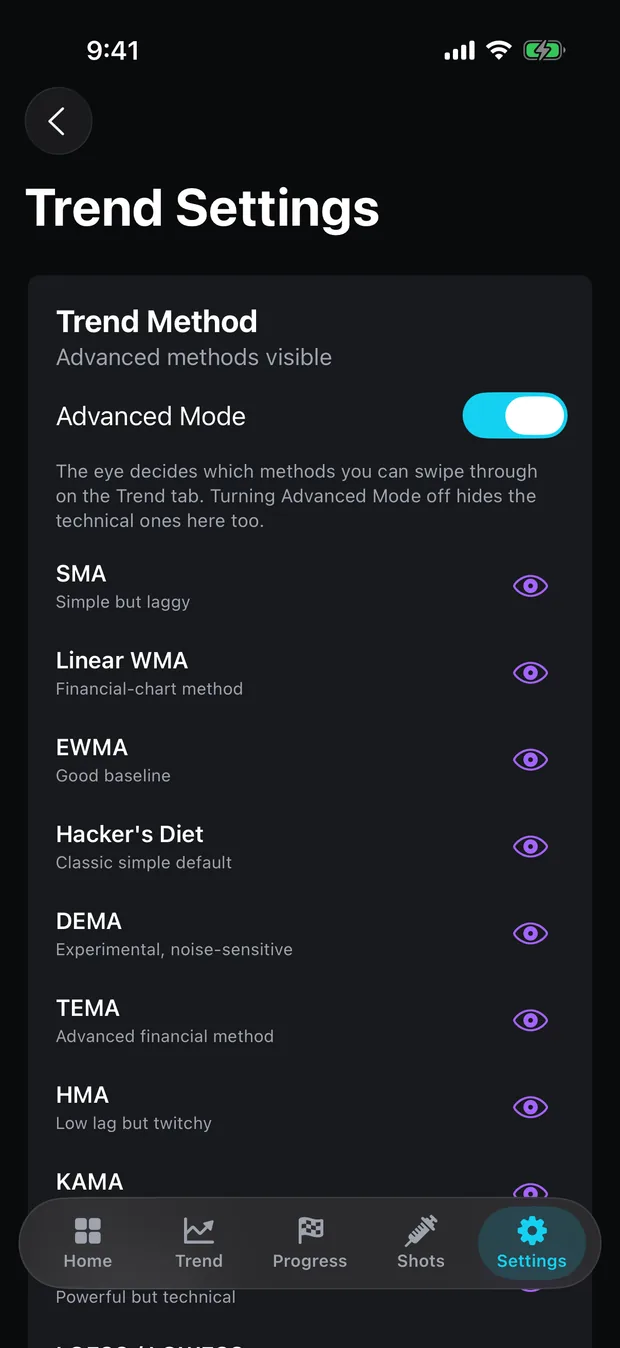
The filter decides the number. Run all fifteen of Peptrend’s methods across that identical file at default parameters and the final trend readings land across 4.0 lb, from 182.9 lb for HMA to 187.0 lb for KAMA. Fifteen defensible answers to one question. At that log’s drift of 0.098 lb/day, 4.0 lb is 41 days of real progress. An undisclosed filter gives you one of those answers with no way to tell which. Choosing a trend method is about picking your spot in that range deliberately; the method list has every formula.
| Shotsy | Peptrend | |
|---|---|---|
| What it is | GLP-1 shot tracker | shot tracker plus published trend maths |
| Dose log | shot history, dose planning, side effects | mg, time, site, route, taken, pain, vial |
| Injection site rotation | tracks previous sites, suggests the next | round-robin by dose count over the sites you have used |
| Smoothing algorithm named | no | 15, formula printed for each |
| Reconstitution maths | not advertised | vial strength ÷ water = mg/mL |
| Apple Health | imports weight, calories, protein, water | reads body mass, writes manual weigh-ins back; Athlete Mode (coming in 1.4.0) reads ten fitness metrics when switched on |
| Export | JSON, a partial export | |
| Platforms | iPhone only (iOS 18) | iPhone, iPad (iOS 17) |
| US App Store, 18 Sep 2026 | 4.84 from 32,064 ratings | — |
Which app rotates injection sites better?
Shotsy describes a rotation that reads your history: “Shotsy tracks where you’ve injected previously and suggests the next site in your rotation.” Peptrend’s suggestion is cruder: it takes the count of doses you have logged, divides by the number of sites in your list, and offers the site the remainder lands on. Round-robin, by count. It does not weight a site by how long since you last used it, and it will not warn you that one spot is carrying more than its share.
The site list is at least learned. Saving an injection adds that site to the rotation, so the list grows into whatever vocabulary you already use, and oral doses never add one. Injection site rotation works through what a counter can and cannot tell you, and it does not oversell the counter.
If rotation guidance is the feature you are choosing on, this comparison points at Shotsy. Several peptide-focused apps advertise interactive body maps too, and the 2026 roundup covers them.
Does Shotsy have a reconstitution calculator?
A keyword scan of Shotsy’s complete App Store description on 18 September 2026 returned zero hits for reconstitution, vial, bacteriostatic, BAC, compound, mg/mL or syringe. The same scan came back empty for MeAgain (33,400 US ratings) and Glowise (6,495). Three trackers, and none of them advertises the arithmetic of mixing a vial.
Peptrend’s calculator takes two inputs and returns one number. Vial strength in mg, bacteriostatic water in mL, out comes concentration in mg/mL to two decimal places, with an optional saved record of the mix date and a label. That is the whole feature. The mg/mL arithmetic is one division.
What it refuses to do is work out a draw volume. Feed a calculator a target dose and have it return millilitres or insulin units and the app becomes a drug dosage calculator under App Store Review guideline 1.4.2, which requires it to “come from the drug manufacturer, a hospital, university, health insurance company, pharmacy or other approved entity, or receive approval by the FDA or one of its international counterparts”. Peptrend used to compute that number. Those functions are gone. Why a calculator should refuse is the longer version of that decision.
How does each app show what is still in your system?
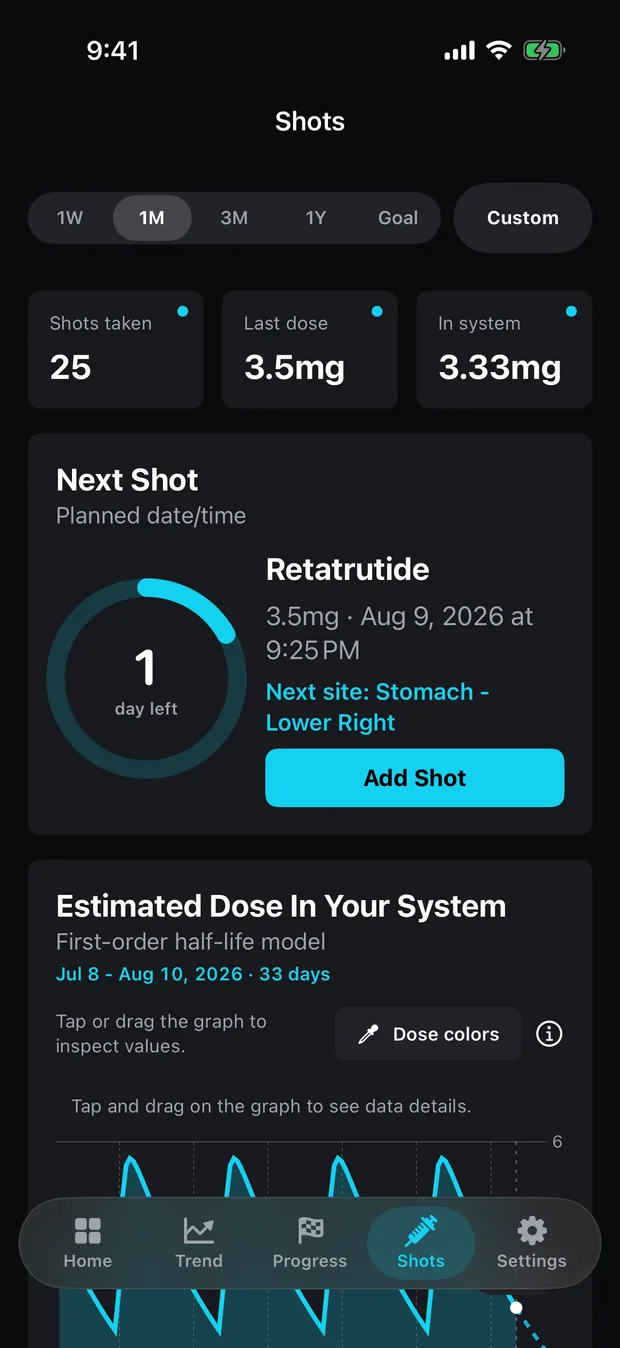
Peptrend draws a second line under the dose log: a modelled estimate, in milligrams, of how much of each dose is still in the body. Shotsy charts something comparable: its App Store description offers medication levels over time, from charts it says are “based on peer-reviewed clinical data”. It names neither the model nor the papers. Peptrend names both. Eleven medication presets ship with a published half-life, a Tmax and a bioavailability figure, and the app shows its pharmacokinetic sources on screen as live links — FDA labels for most of the approved drugs, and published papers for oral semaglutide’s absorption and retatrutide. Orforglipron is cited to a phase 1a paper in version 1.3.3 and to the Foundayo label in 1.4.0, which is in App Review as this is published. Semaglutide is set at a 7.0-day half-life and a 48-hour Tmax, against the Ozempic label’s “elimination half-life of approximately 1 week” and a maximum concentration “reached 1 to 3 days post dose”. Five presets are flagged “Not FDA approved, research use only.” and their half-lives are best published estimates.
From those constants the app runs a one-compartment model with first-order absorption and first-order elimination, sums it over every dose marked taken, and plots the result forward to ten half-lives. The units are milligrams. The number is a decayed-and-absorbed milligram amount derived from a published half-life. No volume of distribution, no ng/mL. The app’s own copy tells you to read the curve as a shape. Half-life and steady state explains why a weekly injection stacks for a month before the level settles, and what to log with every dose covers the fields that make the curve worth drawing.
When is Shotsy the better app?
Health nutrition import, side effects and PDF export. All three are genuine advantages.
Its Health integration reaches nutrition: it imports weight, calories, protein and water, and Peptrend never asks Health for a nutrition type. Peptrend reads body mass in the foreground only and writes back the weigh-ins you enter by hand, if you allow it; Athlete Mode, arriving in 1.4.0, adds ten read-only fitness metrics, requested only when you turn the mode on. Shotsy exports PDF; Peptrend’s export is JSON, and a partial one — no vials, schedules, sites, settings or pain levels. It tracks side effects as a first-class feature, where Peptrend records a 0–10 pain rating on injections and nothing else.
Shotsy also advertises dose planning. Peptrend keeps a schedule and fires one local reminder, and it deliberately does not build or recommend a titration schedule. It charts the ramp you already chose, which is a smaller claim. Titration and how to chart it is explicit about that boundary.
Is Shotsy free, and what does Peptrend keep free?
Shotsy says most of it is. Its FAQ, checked on 18 September 2026, calls the app “completely free to download and use” and puts dose and side-effect tracking, weight charts and nutrition logging at no cost, with premium tools on top. By that date its listing also advertised estimated medication levels for semaglutide, tirzepatide, liraglutide and dulaglutide, daily pills beside weekly injections, and several medications at once on separate schedules. The listing does not say which of those sit in the free tier. Only the app itself can settle that, and nothing here comes from installing it.
Peptrend’s line is written in its source. Every dose and weigh-in, the In Your System chart and its Home card, the Next Shot card, the reminder, Apple Health weigh-in sync and iCloud sync carry no Pro gate. The weight trend line and everything computed from it are Pro. So a free level chart is no reason to choose one app over the other until you have opened Shotsy and looked. What differs is how much of the estimate you can see: Peptrend names the model, shows the half-life, time to peak and absorbed fraction behind the curve, and lets you change each one. It also follows one medication at a time, where Shotsy advertises several. How much is still in your system explains the estimate, and free GLP-1 tracker apps sets ten trackers’ free tiers side by side.
How much does Shotsy cost?
App Store In-App Purchase panels list top SKUs including promotional, regional and A/B-test variants, so no single figure describes what a given user is offered. On 18 September 2026 Shotsy’s US panel listed five distinct SKUs:
| Listed SKU, US App Store, 18 Sep 2026 | Price |
|---|---|
| Monthly | $9.99 |
| Monthly | $14.99 |
| Monthly | $19.99 |
| Yearly | $39.99 |
| Yearly | $59.99 |
Shotsy is free to download, and its FAQ keeps the core features free. Peptrend’s own tiers are on its App Store listing, which is the only authority worth quoting for either app, and what stays free itemises what survives without a subscription.
Which one should you install?
If you want a shot log, side-effect tracking, a rotation suggestion that reads your history, and a PDF export, Shotsy is the established answer and 32,064 US ratings back it. Nothing here argues otherwise.
Peptrend covers the narrower case — the weight line under the daily noise, the filter that drew it named, and a vial record and decay curve on the same timeline as the doses. That is a smaller audience than Shotsy’s by a wide margin. The comparison against Happy Scale is the one where a proprietary default algorithm is the argument, and the comparison against TrendWeight is the harder fight, because TrendWeight is free, open source, and publishes everything.
The method list is public, and it costs nothing to read. John Walker printed his smoothing constant in The Hacker’s Diet and called it roughly equivalent to a 20-day simple moving average for lag; the Third Edition of that book dates from 1994. Thirty-two years on, most of this category still will not tell you which filter drew your line. If the arithmetic here looks wrong, say so through support.
Common questions
Does Shotsy have a reconstitution calculator?
It does not advertise one. A keyword scan of its full App Store description on 18 September 2026 returned no hits for reconstitution, vial, bacteriostatic, BAC, compound, mg/mL or syringe, and shotsyapp.com mentions compounded medications but never reconstitution, vials or syringes. The same App Store scan came back empty for MeAgain (33,400 US ratings) and Glowise (6,495).
What smoothing does Shotsy use for its weight trends?
It does not say. Neither shotsyapp.com nor the App Store description names an algorithm. The site describes the feature as charts you can view 'weekly, monthly, or since you started your GLP-1 journey'. Those are time ranges, and they say nothing about the filter.
Can I move my dose history from another app into Peptrend?
Peptrend imports one file type: JSON with a top-level days array carrying shots and weights. Its own source code labels doses that arrive this way shotsyImport. The import summary reports how many rows landed, how many were duplicates and how many fields it skipped, so a real export is the only honest test.
Is Shotsy free?
Shotsy's FAQ, checked 18 September 2026, says it is completely free to download and use, with dose and side-effect tracking, weight charts and nutrition logging at no cost and premium tools on top. Its App Store listing does not say which tier includes its estimated medication levels. In Peptrend the level chart is free and the weight trend chart is Pro.
How much does Shotsy cost?
There is no single answer to quote. Its App Store In-App Purchases panel on 18 September 2026 listed five distinct SKUs: monthly at $9.99, $14.99 and $19.99, and yearly at $39.99 and $59.99. That panel shows promotional, regional and A/B-test variants, so it is not the offer any individual user sees.