Started logging mid-treatment? Why the level estimate reads low
Because the model counts only the doses in the log. Begin logging a weekly semaglutide course part-way through and, at the app's settings, the estimate reads 50% of the full-history figure a week in, 75% after two doses and 94% after four. Tirzepatide catches up a little faster, 95% by day 21. Adding earlier doses with their real dates fixes it at once.
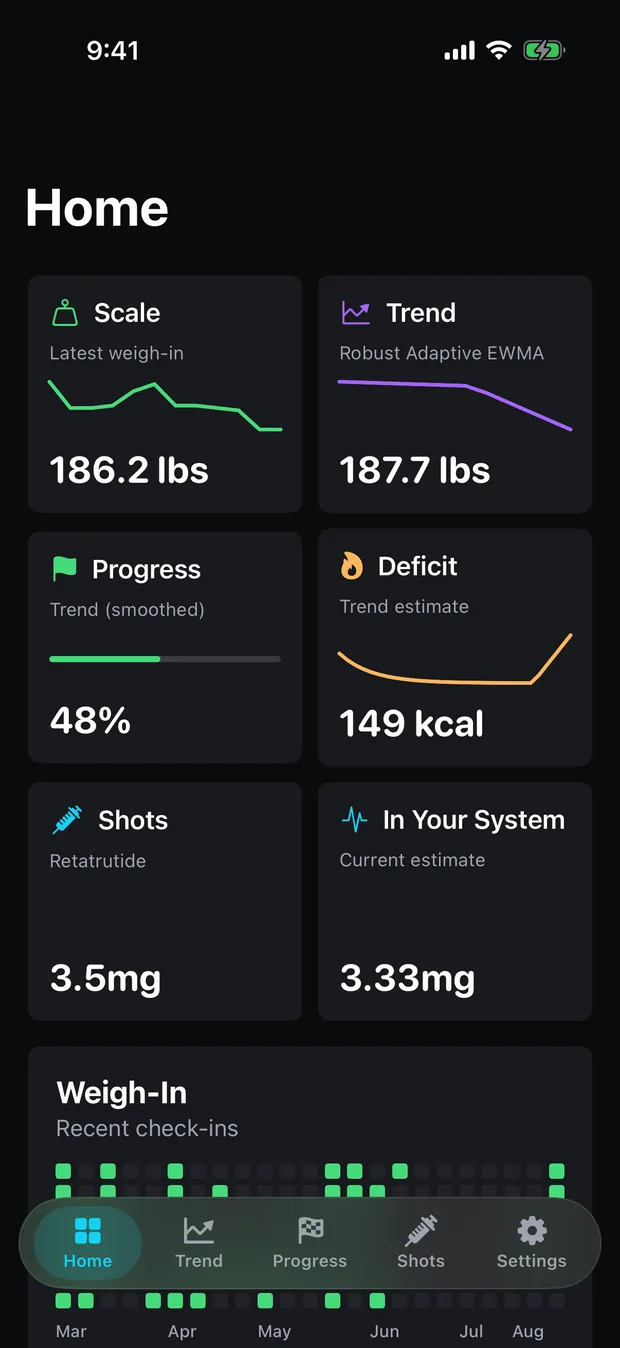
Plenty of people find a dose tracker three months into a course. They log this week’s dose, open the In Your System card, and see a figure that looks too low for where they are. The figure is low, and for a plain reason: the model only knows what is in the log. This post shows how far off it runs, for how long, and how to close the gap.
Why does a new log under-read?
Because the estimate is a sum over logged doses, and an empty log before the first entry counts as no doses at all. Peptrend’s model takes each dose marked as taken, works out how much of it the published half-life and time to peak leave in the body now, and adds the results. Doses you took before you started logging are not in that sum.
On a weekly medication that matters a lot. Each dose lands on what is left of the earlier ones, so a course in its third month carries several weeks of residue. A log that starts in month three throws all of that away and reports one dose’s worth, then two, until the logged history is long enough to rebuild the stack.
The estimate is a decayed milligram amount from a one-compartment model, never a blood level. How much is still in your system explains it.
How low does it read, and for how long?
The table runs the app’s own model for a course that has been going steadily for months, logged from one dose onward with nothing before it. Each figure is the logged-only estimate as a share of the figure a complete history would give, read just before the next dose.
| Logged so far | Semaglutide injection, weekly | Tirzepatide, weekly |
|---|---|---|
| 1 dose | 50.0% | 62.1% |
| 2 doses | 75.0% | 85.6% |
| 3 doses | 87.5% | 94.6% |
| 4 doses | 93.8% | 97.9% |
| 5 doses | 96.9% | 99.2% |
| 6 doses | 98.4% | 99.7% |
Semaglutide’s line is unusually tidy. At the app’s 7.0-day half-life the half-life equals the weekly interval, so each logged dose closes half of the remaining gap. The estimate reaches 95% of the full figure about 28 days after the first logged dose and 99% at about 43. Tirzepatide’s 5.0-day half-life gets there sooner: 95% at about day 21, 99% at about day 28.
Daily tablets differ by drug. At the semaglutide tablet’s 6.5-day half-life, the logged-only estimate is 57% of the full figure a week in, 80% at two weeks and 96% at four, with 99% at about day 43. Orforglipron’s 1.6-day half-life closes the gap in days: 95% at about day 6 and 99% at about day 10.
Why four to five half-lives?
Because that is how long a regular dosing pattern takes to build its plateau, and the same arithmetic governs how long a missing history takes to stop mattering. After four half-lives, the doses you did not log carry about 6% of their effect on the sum; after five, about 3%. Both prescribing labels describe steady state in these terms: the semaglutide injection’s label puts it at 4 to 5 weeks of weekly dosing.
So a complete log does not need to go back to the first dose of the course. It needs to cover the last four to five half-lives. For weekly semaglutide or tirzepatide that is about a month. For a daily tablet at a 1.6-day half-life it is about a week. Steady state builds the plateau dose by dose.
How do you backfill earlier doses?
Add them with their real dates. The Add sheet’s When field takes any date and time in the past. Log each earlier dose as taken, with its amount, and the curve redraws as if the log had always started there. The pharmacy record, a pen box or another app’s history are the usual sources for dates.
Three faster routes exist:
- An export from another tracker. Settings › Import / Export reads a JSON file in the shape several dose trackers already export, with a
daysarray. Doses already in the log are recognised as duplicates and skipped, so importing twice does no harm. - Weigh-ins from Apple Health. Refresh Apple Health Data on the Trend tab reads every body-mass sample Health holds, back to the first. Importing from Apple Health covers what crosses over.
- Approximate dates. If you know the day but not the hour, the day is enough. A few hours either way on a dose four weeks old moves the current figure very little at a week’s half-life.
What else does a short history affect?
The next-dose date and the dose colours. The Next card counts from your last taken dose, which a backfill does not change unless you log something later than what is there. Dose colours run from your lowest logged dose to your highest, so a log that begins at the current dose has nothing to compare it with until earlier, smaller doses are added. How to chart a titration shows the ramp a full history draws.
The weight trend has its own warm-up, separate from all this: every trend method starts at your first weigh-in. How many weigh-ins a trend needs measures that one.
None of this needs Pro. Logging, backfilling, the import and the In Your System card are free. If the card still reads oddly once the history is complete, support is the place to ask.
Common questions
Why is my In Your System number lower than expected?
The most common reason is a log that starts part-way through a course. The model sums the doses it has been given and assumes nothing before the first one, so it under-reads until the log covers four to five half-lives.
Can I add doses I took before I installed Peptrend?
Yes. The Add sheet's When field accepts any past date and time, and a JSON export from several other dose trackers can be imported in Settings › Import / Export. Weigh-ins already in Apple Health can be read in with Refresh Apple Health Data.
How far back do I need to log?
About four to five half-lives before today. For a weekly injection with a half-life near a week that is roughly a month; for a daily tablet with a 1.6-day half-life, about a week.
Sources
- OZEMPIC (semaglutide) injection — prescribing information, section 12.3, DailyMed
- MOUNJARO (tirzepatide) injection — prescribing information, section 12.3, DailyMed
- Wadhwa RR, Cascella M. Steady State Concentration. StatPearls, NCBI Bookshelf
- Hallare J, Gerriets V. Elimination Half-Life of Drugs. StatPearls, NCBI Bookshelf